Showing posts with label Banking. Show all posts

Wednesday, December 18, 2013

Managing in a Global Economy: Demystifying International Macroeconomics (Economic Applications, InfoTrac Printed Access Card), 1st Edition, John E. Marthinsen


http://www.amazon.com/gp/product/0324395507/ref=as_li_ss_tl?ie=UTF8&camp=1789&creative=390957&creativeASIN=0324395507&linkCode=as2&tag=freemanagementzon-20


Marthinsen's MANAGING IN A GLOBAL ECONOMY: DEMYSTIFYING INTERNATIONAL MACROECONOMICS is written specifically for MBA students and addresses important issues confronting business managers. This exciting new first edition presents macroeconomics in the context of real world decision-making, It helps students grasp practical "big picture" concepts, nurtures an understanding of what causes macroeconomic variables to change, and relates these changes to issues confronting managers.

Marthinsen integrates the three major macroeconomic sectors (i.e., the real goods market, real loanable funds market, and foreign exchange market) in a user-friendly way with a minimum of math and only supply and demand analysis. Liberating readers from dry, overly complex macroeconomic models, Marthinsen uses theory only as a means to an end for practical understanding.

Clear and concise, the book focuses on concrete business examples to show how economic shocks, such as monetary and fiscal policies or shifts in international capital flows, affect management decisions. The book was written for MBAs who were not necessarily economics majors, making it appealing to students with a variety of undergraduate backgrounds.

Marthinsen keeps readers visually engaged with strategic use of figures, tables, charts, and illustrative exhibits. MANAGING IN A GLOBAL ECONOMY offers a strategic focus, emphasizes the interaction among markets, and equips MBAs with a macroeconomic perspective that will last (and be used) for years.

I happened to be one of the student who had access to this texbook a year before it was released. Fantastic Material! You really start getting the Macro Econimic picture in terms of where the exchange rates, interest rates are headed etc. Great book for a person who wants to understand forecast the state of economy and its business impact

I had the opportunity to take a Macroeconomics class with Professor Marthinsen when he was putting the final touches on the book. It is easily the most accessible economics text I have read, which was important because I was a Psychology major in undergrad (not a business major). The book has a great blend of being comprehensive/thorough while still being accessible. I recommend it to any MBA interested in understanding macroeconomics and how these macro factors can influence a business.

Written well for anyone with little to no prior background in macroeconomics to pick up and start reading. Covers all of the critical issues with just enough depth to hold down a conversation.

Given the dryness of the subject matter this book is pretty entertaining, and explains complex technical concepts simply and well. It's not difficult to follow, and is better than some textbooks that I've used on this subject.

This was a great book, expertly written with students in mind. The explanations are very clear and straight-forward. Highly recommended!

Product Details :
  • Hardcover: 768 pages
  • Publisher: Cengage Learning; 1 edition (February 12, 2007)
  • Language: English
  • ISBN-10: 0324395507
  • ISBN-13: 978-0324395501
  • Product Dimensions: 1.3 x 7.5 x 9.2 inches

More Details about Managing in a Global Economy: Demystifying International Macroeconomics (Economic Applications, InfoTrac Printed Access Card), 1st Edition

Tuesday, December 17, 2013

Organization Theory: A Public and Nonprofit Perspective, 3rd Edition, Harold F. Gortner

http://www.amazon.com/gp/product/0495006807/ref=as_li_ss_tl?ie=UTF8&camp=1789&creative=390957&creativeASIN=0495006807&linkCode=as2&tag=freemanagementzon-20


Master organizational theory with ORGANIZATION THEORY: A PUBLIC AND NON-PROFIT PERSPECTIVE! With coverage of how organizational theories relate to both government and nonprofits, this political science text provides you with information that is vital for your future career. A book specific website provides case studies, review materials, and links for further exploration that help you discover how theory applies to real-life. Studying is made easy with tools found throughout the text such as review questions, a glossary of important terms, ethical considerations, and the impact of technology on government and nonprofit organizations.

Review
Preface. 1. Organization Research and Theory. 2. Blurring Sectors: Public and Private. 3. Pivotal Controversies. 4. Structure. 5. Communication. 6. Accountability and Transparency. 7. Decisionmaking. 8. Motivation and Culture. 9. Leadership. 10. Change and Stability. Glossary. Index (an author index and a subject index).

About the Author
Harold F. Gortner is professor emeritus of government and politics at George Mason University in Fairfax, Virginia. Dr. Gortner's research and teaching interests are in the areas of organization theory, public administration ethics, public management, and Canadian politics. In addition to holding administrative positions at the university, he has worked in state government agencies and taught in and consulted with foreign universities. Other publications include ADMINISTRATION IN THE PUBLIC SECTOR and ETHICS FOR PUBLIC MANAGEMENT, along with articles and chapters in a variety of public administration journals and anthologies.

Kenneth L. Nichols is associate professor of public policy and administration at the University of Maine. Dr. Nichols' research and teaching interests include organizational change, technology impact, futures research techniques, ethics in the workplace, and administrative themes in literature. A former administrator with the Internal Revenue Service, he has co-edited ENTERPRISE GOVERNMENT: FRANCHISING AND CROSS-SERVICING FOR ADMINISTRATIVE SUPPORT and published articles about organizational change, ethics, older employees, tax policy, and technology dissemination. He is developing a how-to book of strategic management and forecasting tools.

Carolyn Ball is an associate professor of public policy and administration and director of public administration graduate programs at the University of Maine in Orono. Dr. Ball's teaching and research interests include diversity¿particularly religious diversity in the workforce¿and organizational behavior and culture, as well as evaluation. She has published articles on religion, community policing, domestic violence, and evaluation. She has worked in a state workforce development agency and in healthcare and youth nonprofit agencies. Her consulting experience includes working with state and local transportation and public safety departments.

Product Details :
  • Paperback: 448 pages
  • Publisher: Cengage Learning; 3 edition (October 2, 2006)
  • Language: English
  • ISBN-10: 0495006807
  • ISBN-13: 978-0495006800
  • Product Dimensions: 0.6 x 6.4 x 9.1 inches

More Details about Organization Theory: A Public and Nonprofit Perspective, 3rd Edition

Monday, December 16, 2013

Writing Effective Policies and Procedures: A Step-By-Step Resource for Clear Communication, 1st Edition, Nancy J. Campbell

http://www.amazon.com/gp/product/081447960X/ref=as_li_ss_tl?ie=UTF8&camp=1789&creative=390957&creativeASIN=081447960X&linkCode=as2&tag=freemanagementzon-20


Book Description
"Policies and procedures -- they're what make a company run efficiently and legally. Now managers have a definitive guide to creating accurate policies and procedures documents. The book is useful for professionals in such areas as:

* health and safety * human resources * office management * administration * quality
* manufacturing * customer service * finance and accounting.

Readers will enjoy the unusually friendly, informal approach of this book. Loaded with examples, checklists, guidelines, quick tips, work plans, and forms, it is ready for immediate use. The book shows how to:

* write (and design) documents clearly (so employees will understand and follow the policies)
* plan, analyze, and research each element
* help employees increase efficiency, reduce mistakes and frustration, and save time and money -- by providing clear guidelines to follow
* avoid legal mistakes that can get a company in trouble."

About the Author
NANCY J. CAMPBELL (Kansas City, MO) is a trainer, facilitator, and speaker specializing in the development of management skills to enhance employee performance.

The book is easy to read and understand. It provides helpful guidelines and background material to design procedures. It works a bit as a checklist, in order to remember all the elements in procedure writting. However, it's not meant for any particular industry, and is very general. I would have liked to find more specific examples, and maybe sections for particular industries.

This book was very helpful in getting started with the procedures that our department so desparately needed. The book didn't mention the computer industry in particular but everything applied. It helped us get the information extracted from the appropriate people, pick a format, plan, and write. The book is easy to read and not dry at all. The 'tools and resources' check lists were great. This book was worth the price tag for me.

Some of the basic writing tips regarding word choice, sentence length, reading level, and formatting are great. The rest might apply if your company has never documented its policies and procedures before or if you work in a static workplace (government office?) where policies or procedures are added or changed only a couple of times a year (do people really still print these on paper?) However, if you work at a dynamic, constantly changing company that must respond to thousands of different customer queries a day, much of the advice is not applicable.

Product Details :
  • Plastic Comb: 412 pages
  • Publisher: AMACOM (January 1, 1998)
  • Language: English
  • ISBN-10: 081447960X
  • ISBN-13: 978-0814479605
  • Product Dimensions: 1.1 x 8.7 x 10.8 inches

More Details about Writing Effective Policies and Procedures: A Step-By-Step Resource for Clear Communication, 1st Edition

Friday, December 6, 2013

The Firm of the Future: A Guide for Accountants, Lawyers, and Other Professional Services, 1st Edition, Paul Dunn


Review
For the Back Cover: "In The Firm of the Future, Ron Baker and Paul Dunn create an intellectual challenge for firm leaders. They are truly two of the best critical thinkers today. Together they provide the reader with a wealth of thought-provoking ideas. This is an intellectual masterpiece." —August J. Aquila, Ph.D. Managing Director, American Express Tax and Business Services and Co-Author of CPAs That Sell and CPA Firm Mergers That Work "When I first received my copy of The Firm of the Future I was intimidated by its size and began reviewing the table of contents for the sections that seemed most interesting to me. But, as I am prone to do, I began at the first page. I soon found myself pouring through the book, chapter by chapter. Paul Dunn and Ron Baker have compiled a work that has incredible depth, wisdom, and insight. What I enjoyed most, however, was the conversational tone that makes this book hard to put down. I feel like I have had a personal conversation with wise counselors who understand my business." —Michael C. Knowles, Partner, Frank, Rimerman + Co., LLP, Menlo Park, California

For the Front Matter of the Book: Praise for The Firm of the Future "This is an absolutely must read for any business (and that includes accounting practices) who want to be in business in the future - written in a highly readable style and laced with hundreds of practical 'how to' notes and comments this book is a prerequisite business manual for any practitioner of any professional service organization. This really is a stunning book - I've thoroughly enjoyed the philosophy as well as the practical how to and why and will further refine our approach to the business - loved the style and class of the book." —Peter Byers, Chartered Accountant, New Zealand

"Excited is probably the most appropriate word for how I felt as I read the book. Excited at the learnings, excited at the possibilities that opened before me, excited at what it would be like to work in a practice with no timesheets, value pricing, passionate team members and clients more than delighted with the "concierge service" provided by every team member. Ron Baker and Paul Dunn have clearly described what the firm of the future MUST look like. They clearly debunk all the old theories and practices of managing and operating an accounting firm and clearly explains the methods and FEELINGS that must exist in The Firm of the Future." —Harry Rosenburg, BKR Rosenberg+Partners, Melbourne, Australia

"For many years now, I have utilized and professed within my firm, my working theory, 'Our next new client has to have a thirst for our knowledge and the willingness and ability to pay for it.' The Firm of the Future embraces this theory and provides readers with the sound fundamentals to capitalize on their intellectual, social, and human capital." —Robert A. Gaida, Vice Chairman, BDO Seidman, LLP

"Without doubt the single most important book ever written for professionals. It will force the entire profession to question, rethink, and rework everything it does. It's a book that will change your practice and your life—for the better, forever. Thanks to this book the professions will never be the same again." —Steve Pipe, Founder and Chairman, The Added Value Network (U.K.)

"I have no doubt that the revelations that Paul and Ron draw run a parallel. Sometimes the answer is obvious, but only to those not already under water that if they stood on their toes they could lift their heads above water, and it needs someone from outside the pool to see it. You have done this, you have the answer, and like all brilliant business findings it is simple, it is available to all, and it is practical. It requires only a willingness to accept, to change and to grow - a willingness that some have and some will never have, as like troglodytes they cannot accept change." —Dr Chris White, Doctor of Business Administration, PhD, MBA, B.Bus, ALGA, CA, FCPA, CFP JP, Partner KPMG, Cairns

"For many years Ron Baker and Paul Dunn have been wonderful drivers for change in how professional service firms can become more successful. As a result of their collective wisdom, they have now co-authored a powerful and insightful book that should require many firms to reconsider their strategy. The true benefit of adhering to their New Practice Equation will not only be a more profitable firm but one that will also have a distinct competitive advantage in the marketplace. An absolute required reading for business leaders and managers of professional firms." —Robert J. Gallagher, CPA, President - R. J. Gallagher and Associates, Inc.

"Like everything that challenges conventional thinking, this book takes time to absorb. There were many parts that I just had to 'read-over' so that I could filter through the brilliant combination of evidentiary and emotional interplay that Paul and Ron do so well and reveal the truth for myself. The book reads like the early conversations I was privileged to be privy to, and will be touted through the ages as a seminal work on the new evolution of the profession." —Jason Johnson, CEO, Kipara Consulting

"The Firm of the Future imparts the accumulated wisdom of two key people who are helping to shape the profession, in a readable, and memorable manner. And wisdom a plenty Paul and Ron have to impart. The profession has a vital role to play if our capitalist system is to continue its enormous record of success, and to prove to the doubters that is universally the best system man has invented for improving the well being of all people on earth, not just those in the wealthy developed nations. Paul and Ron chart the course by which the profession can regain its significance and, more importantly, help achieve the bigger goals, both for the benefit of its own members and the wider world. I heartily recommend The Firm of the Future as a 'must have' guide for anyone in practice." —David Hartley, Director, ElanElan Ltd.

"Between the covers of this book are more good ideas than you typically find in a dozen business books. Take notes: you'll want to remember these ideas for a long time." —David Maister, author and consultant

"Paul and Ron have brought together their business philosophies under one cover of a book that should be the practice manual in every professional office. It truly is the answer of having the business do the things the professional used to do in a more effective and profitable manner. Who wouldn't want to work in the firm of the future described here?" —Nicholas Newton CA, CMA, Creative Director, Frouin Group

"Ron Baker and Paul Dunn have put together the modern almanac of best business practices. Their firm of the future focuses on its intellectual, networking, cultural, and customer-focused capital to build wealth. They demonstrate over and over how making meaning, not just money, is the key to a leader's success. The book is an excellent read for those who want to learn the best-of-the-best business practices proven in the past decade." —Sheila Kessler, Ph.D., President of Competitive Edge and author, Measuring and Managing Customer Satisfaction

"The Firm of the Future brings a huge number of great ideas together in one place to provide a road map of what a professional service firm must do to position itself for the future. The book provides key success factors any firm can follow in creating a customer-driven firm." —William Cobb, Cobb Consulting, Houston, Texas

"Finally! A book that catapults professional firms to a more sophisticated, more effective approach to management, leadership, and providing value. Any firm that follows the theory and practical advice advocated by Ron and Paul can retain happy and qualified team members, assure growing and loyal clients, reduce the stress of public practice, and reap the benefits of significant profitability." —Martha Sawyer, president of Hudson Sawyer, publisher of Bowman's Accounting Report

"It's refreshing to see a book that focuses the accounting practice on who we truly are - and more importantly, who we should be. We didn't learn this trade to have our services discounted and be held to a minute-by-minute gauge of value. Ron and Paul keep your focus on the ball rather than the scoreboard and clearly define our role as 'Intellectual Capitalists,' not bean counters!" —Mark J. Koziel, CPA, Director, Dopkins & Company, LLP

"Ron Baker and Paul Dunn have done it again. Living up to their reputation for challenging conventional wisdom, Baker and Dunn present a new paradigm for the professions to understand the dynamic forces at play in the professional practice of the 21st century. The Firm of the Future is a brilliant work that adds a new dimension to the old formula for success in a professional service firm. Baker and Dunn clearly lay out a new road map to help leaders understand the differences between leveraging people and leveraging knowledge; between billing for time and pricing for value; and between doing things right and doing the right things. This new paradigm for the firm of the future will help professionals more accurately plan and structure their firm in a way that acknowledges and capitalizes on today's marketplace, technological opportunities, customer expectations and human capital needs. Any practice leader who wants to ensure success for their organization should be compelled to read The Firm of the Future." —Michael Platt, President & CEO, AccountingWEB

"Sometimes, this book takes your breath away with its ambition. Not content with burying a fundamental paradigm of the professions, it offers a new one that challenges all who think about, and care about, their profession to re-evaluate what they do—and why they do it. Brimming with ideas, Baker and Dunn constantly challenge accepted wisdom, but thankfully provide cogent alternatives for your choice. Quotes, illustrations and examples from all sorts of sources driv...

I first read this book about 2 years ago. I keep it within arm's reach of my desk and refer to it often, still.

I've read one reviewer who stated that this book was the modern almanac of best business practices. I agree completely.

I run my own small law firm. We have implemented many of this book's practices with great success and profitablilty. Primary among them is fixed fee agreements. Yes, we are a law firm that has trashed its time sheets, due in large part to the inspiration and impetus of this book. And, we will never go back.

An earlier reviewer suggested that this book would be more useful for CPA's and not for lawyers. I disagree. Though I'm certain the message of this book is critical for CPA's, I think that any person in law firm leadership must read this book. I think it is particularly suited to small firms and solos who will have the ability to immediately take action in implementing these ideas and making them a reality in their practice.

However, if you are one of my competitors forget everything I said above and do not touch this book. My firm and my family will thank you.

Product Details :

  • Hardcover: 360 pages
  • Publisher: Wiley; 1 edition (April 18, 2003)
  • Language: English
  • ISBN-10: 0471264245
  • ISBN-13: 978-0471264248
  • Product Dimensions: 1.2 x 7.4 x 10.2 inches


More Details about The Firm of the Future: A Guide for Accountants, Lawyers, and Other Professional Services, 1st Edition

Wednesday, December 4, 2013

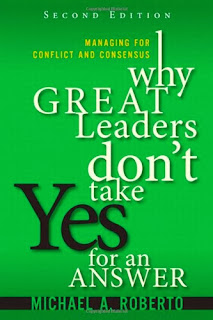
Why Great Leaders Don't Take Yes for an Answer: Managing for Conflict and Consensus, 2nd Edition, Michael A. Roberto

http://www.amazon.com/gp/product/0133095118/ref=as_li_ss_tl?ie=UTF8&camp=1789&creative=390957&creativeASIN=0133095118&linkCode=as2&tag=freemanagementzon-20


From the Back Cover
Praise for the First Edition

“Why Great Leaders Don’t Take Yes for an Answer addresses a perennial and pernicious thorn in the leader’s side—the yes-men in every organization. (And if you think your company is without them, you really need this book!) Leaders at all levels can use Roberto’s advice to make better decisions and align their teams for results.”
—KEN BLANCHARD, Coauthor of The One Minute Manager® and Customer Mania

“Deciding how to decide is a powerful idea that all leaders should understand and put into practice. In doing so, they can become adept at stimulating candid dialogues, testing their company’s core assumptions, and achieving alignment. Roberto’s ideas have already begun to make a profound difference in the effectiveness of our management meetings. Our clients around the world would do well to adopt Roberto’s straightforward recommendations.”
—ED BOSWELL, President and CEO, The Forum Corporation

“Too often leaders mistake silence for agreement. Roberto offers concrete advice on how to beat this trap. A must-read for leaders at all levels.”
—KATHLEEN M. EISENHARDT, Stanford W. Ascherman M. D. Professor, Stanford University and Codirector, Stanford Technology Ventures Program

“In his book Why Great Leaders Don’t Take Yes for an Answer, Roberto provides a unique and very enlightening look into the process of decision making. His thesis around ‘critical consensus building’ is worthwhile reading for any manager or entrepreneur that strives to be the most effective leader they can be.”
—JONATHAN KRAFT, Vice Chairman, New England Patriots

“Unasked questions and undermined decisions are the two main reasons for corporate failure. To avoid these dangerous wrong turns, every executive should study Roberto’s clear road maps for making and implementing decisions.”
—WILBUR L. ROSS, JR., Chairman of the Board, International Steel Group

Leaders still hear “yes” far too often—and they don’t hear bad news until it’s too late. They imagine they’ve achieved consensus, and then they find their decisions undermined by colleagues who never bought in. They become isolated, and even the most dangerous actions can go unquestioned. This remains an enormous problem for leaders and for the entire organization. But is it inevitable? Absolutely not.

In a new edition of his widely praised bestseller, Michael A. Roberto shows how to stimulate constructive debate that leads to better decisions, deeper consensus, and better results. Now reflecting new research and updated case studies, this edition also integrates more valuable guidance on benefiting from “devil’s advocacy” without introducing negativity or costly delay.

Throughout, Roberto offers powerful new insights into managing teams, mitigating risk, and even promoting ethics through effective governance. Whether you’re a senior executive or a project team member, this book will help you leverage your organization’s immense untapped wisdom to optimize both decisions and performance.

DECIDING HOW TO DECIDE: A BETTER FRAMEWORK

Systematically diagnosing, evaluating, and improving your decision-making processes

BALANCING ASSERTIVENESS AND RESTRAINT

Reaching the right decision without micromanaging its content

OVERCOMING THE SILENT BARRIERS TO CANDOR

Promoting the right conflicts—the ones that lead to clarity and progress

CREATING CONSENSUS WITHOUT COMPROMISING CREATIVITY

Using fair and legitimate processes to achieve closure that’s real, not fake About the Author

Michael Roberto is the Trustee Professor of Management at Bryant University in Smithfield, Rhode Island. He has served on the faculty at Harvard Business School and as a visiting professor at NYU’s Stern School of Business. Over the past decade, Professor Roberto has held a position on the faculty of the Nomura School of Advanced Management in Tokyo, where he teaches an executive program each summer.

Professor Roberto’s previous book, Know What You Don’t Know (Pearson/Financial Times, 2009) addresses how leaders can become more effective problem finders. He has created two best-selling audio and video lecture series for The Great Courses ( The Art of Critical Decision Making , 2009, and Transformational Leadership , 2011). His articles have appeared in publications such as Harvard Business Review , MIT Sloan Management Review , and California Management Review.

Professor Roberto’s research and teaching have earned several major awards. The Everest Leadership and Team Simulation earned an MITX Interactive Award for Best E-Learning Solution in 2011. Columbia’s Final Mission , a multimedia case study about the 2003 space shuttle accident, garnered the software industry’s prestigious Codie Award in 2006. On the teaching front, Professor Roberto is a seven-time winner of the Outstanding MBA Teaching Award at Bryant University. He has been awarded Harvard’s Allyn Young Prize for Teaching in Economics on two occasions. Professor Roberto received an AB with honors from Harvard College, an MBA with High Distinction from Harvard Business School, and a doctorate from the Harvard Business School.

Professor Roberto lives in Massachusetts with his wife, Kristin, and his three children, Luke, Celia, and Grace.

Product Details :
  • Hardcover: 304 pages
  • Publisher: FT Press; 2 edition (May 19, 2013)
  • Language: English
  • ISBN-10: 0133095118
  • ISBN-13: 978-0133095111
  • Product Dimensions: 1.1 x 6.1 x 9.1 inches

More Details about Why Great Leaders Don't Take Yes for an Answer: Managing for Conflict and Consensus, 2nd Edition

Tuesday, December 3, 2013

Competing Values Leadership: Creating Value in Organizations (New Horizons in Management), 1st Edition, Kim S. Cameron


Creating value in a firm is an enormously complex endeavor. Yet, despite its complexity, value creation is the objective of every enterprise, every worker, and every leader. The Competing Values Framework can help leaders understand more deeply and act more effectively. In the first book to comprehensively present this framework, the authors discuss its core elements and focus attention on rethinking the notion of value. They emphasize specific tools and techniques leaders can use to institute sustainable change.

The Competing Values Framework was developed in response to the need for a broadly applicable model that would foster successful leadership, improve organizational effectiveness, and promote value creation. It helps leaders think differently about value creation and shows them how to clarify purpose, integrate practices, and lead people. Named one of the 40 most important frameworks in the history of business, it has been studied and tested in organizations for more than 25 years. Currently used by hundreds of firms around the world, the Competing Values Framework serves as a map, an organizing mechanism, a sense-making device, a source of new ideas, and a learning system.

This accessible resource will be of great use to organizational scholars interested in the concepts of value creation, organizational effectiveness, and competing values; to leaders and managers interested in enhancing and creating value in their organizations; and to change agents and consultants who use the Competing Values Framework as part of their intervention strategies or who are looking to help improve organizations.

Review
'This is a very readable and excellently presented volume. It will interest anyone concerned with organizational effectiveness and the competing values model.' - Economic Outlook and Business Review 'I recommend this book to anyone wishing to understand and practice leadership. Leadership is often treated in mutually-exclusive categories, such as Theory X vs. Theory Y, managers vs. leaders, transactional vs. transformative, initiation vs. consideration, etc. The Competing Values Framework presented in this book transcends these dualities. It features eight competing but complementary values that are critical for managing today's complex and pluralistic organizations.

The framework emphasizes the need for balance among the eight leadership roles, and an appreciation of the context, timing, and contingencies when the leadership roles facilitate and inhibit collective endeavors. I have followed the development and testing of the Competing Values Framework over the years. It makes important contributions to both theory and practice. It stimulates positive learning outcomes for students and managers.' - Andrew H. Van de Ven, University of Minnesota, US

About the Author
Kim S. Cameron, Professor of Management and Organization, Robert E. Quinn, Margaret Elliott Tracey Professor of Business Administration, University of Michigan, Jeff DeGraff, Professor of the Practice of Management, Ross School of Management, University of Michigan, Ann Arbor, US and Anjan V. Thakor, John E. Simon Professor of Finance, Olin School of Business, Washington University, US

As a doctoral candidate in business management, I have leadership books growing out of my ears. When I discovered Competing Values Leadership, I prepared myself for the worst, secretly hoping these authors would offer a unique perspective on leadership that not only offers value but also demonstrates how leadership affects the bottom line in business. Fortunately, I wasn't disappointed.

Competing Values Leadership is organized into two main parts, sub-divided into nine chapters. It includes a list of figures and tables used throughout the book to demonstrate key components of the Competing Values Leadership framework.

Part I overviews the competing values theory and explains the four-quadrant visual model underlying this theory. The authors propose that "hundreds of organizations have used the framework to diagnose and implement culture change, establish competitive strategy, motivate employees, facilitate organizational development and change, implement quality processes, (and) develop high potential leaders..." (p. 12).

Cases including Philips Electronics, Dana Corporation, Dell, General Dynamics, and SPX are provided to demonstrate value created by application of the framework which is divided into quadrants describing four value-creating leadership activities: Collaborate, Create, Compete and Control. The authors assert that balanced application of these competing values, preferences, and priorities which exist in all organizations will yield more value and better financial results.

Part II discusses additional applications of the model and how behaviors of the Competing Values Leadership model can result in value creation and higher financial performance.

Since the authors are researchers and academics, Competing Values Leadership is not a book easily examined cover-to-cover. It's filled with quantitative charts and research terms like "multiple regression" and "predictive analysis" unfamiliar to the typical business audience. Yet, once readers wade through the academic jargon, they will discover that the Competing Values Leadership model offers valuable insights into the inherent paradox of leadership and why leadership is actually a balancing act among extremes rather than a simple fix for organizational challenges.

Armchair Interviews highly recommends this book for business professionals and leadership researchers interested in understanding a new approach to leading people, building organizational effectiveness, and achieving higher financial performance.

Product Details :

  • Series: New Horizons in Management
  • Paperback: 192 pages
  • Publisher: Edward Elgar Publishing (September 26, 2007)
  • Language: English
  • ISBN-10: 1847204953
  • ISBN-13: 978-1847204950
  • Product Dimensions: 5.8 x 9 inches


More Details about Competing Values Leadership: Creating Value in Organizations (New Horizons in Management), 1st Edition

Saturday, November 30, 2013

Customer and Business Analytics: Applied Data Mining for Business Decision Making Using R (Chapman & Hall/CRC The R Series), 1st Edition, Daniel S. Putler


Customer and Business Analytics: Applied Data Mining for Business Decision Making Using R explains and demonstrates, via the accompanying open-source software, how advanced analytical tools can address various business problems. It also gives insight into some of the challenges faced when deploying these tools. Extensively classroom-tested, the text is ideal for students in customer and business analytics or applied data mining as well as professionals in small- to medium-sized organizations.

The book offers an intuitive understanding of how different analytics algorithms work. Where necessary, the authors explain the underlying mathematics in an accessible manner. Each technique presented includes a detailed tutorial that enables hands-on experience with real data. The authors also discuss issues often encountered in applied data mining projects and present the CRISP-DM process model as a practical framework for organizing these projects.

Showing how data mining can improve the performance of organizations, this book and its R-based software provide the skills and tools needed to successfully develop advanced analytics capabilities.

Review
"This book is derived from a lecture course in data mining for MBA students. … assumes very little in the way of mathematical or statistical background. The writing style is generally good, and the book should prove useful to its target audience." —David Scott, International Statistical Review (2013), 81, 2

About the Author
Dr. Daniel S. Putler is a Data Artisan in Residence at Alteryx, a business intelligence/analytics software company.

Dr. Robert E. Krider is a professor of marketing in the Beedie School of Business at Simon Fraser University. He has also taught in Hong Kong, Shanghai, Portugal, and Germany. His research tackles questions of customer and competitor behavior in retailing and media industries.

One of a few R data mining books that explain several concepts, such as decision trees, lift chart, etc. step by step using good examples.

Product Details :

  • Series: Chapman & Hall/CRC The R Series
  • Hardcover: 315 pages
  • Publisher: Chapman and Hall/CRC; 1 edition (May 7, 2012)
  • Language: English
  • ISBN-10: 1466503963
  • ISBN-13: 978-1466503960
  • Product Dimensions: 0.8 x 7.1 x 9.8 inches


More Details about Customer and Business Analytics: Applied Data Mining for Business Decision Making Using R (Chapman & Hall/CRC The R Series), 1st Edition

Friday, November 29, 2013

Managing: A Competency-Based Approach, 11th Edition, Don Hellriegel


Maximize your management potential with the unique competency-based approach found only in Hellriegel/Jackson/Slocum's MANAGING: A COMPETENCY-BASED APPROACH, 11e. This unique text blends theory, applications and innovation to prepare you with the skills most critical for management success today. The text's solid presentation of today's management principles and proven, interactive learning features throughout the book focus on six managerial competencies--self-management, strategic action, planning and administration, global awareness, and teamwork.

The authors developed these competencies based on input from hundreds of successful managers in business of all types and sizes to help you streamline your personal managerial development. Fresh examples from well-known organizations, the latest cases, new Ethical Challenges, and experiential exercises demonstration how these competencies are used by real managers to address the challenges of managing and leading their organizations. Integrated Self-Assessments help you analyze and further develop your own management potential for career success as you compare your skills to other students and professionals around the world. Videos showing management in action within recent Hollywood films and an innovative new CengageNOW online learning system to assist you with homework and review all further ensure you develop the strong managerial competencies to lead with confidence.

About the Author
Don Hellriegel is Emeritus Professor of Management in the Mays Business School at Texas A&M University. Dr. Hellriegel joined the faculty at Texas A&M in 1975. He has also taught at the Pennsylvania State University and the University of Colorado. He received his B.S. and M.B.A. from Kent State University and his Ph.D. from the University of Washington. His research interests include organizational behavior, the effects of organizational environments, managerial cognitive styles, and organizational innovation and strategic management processes. His research has been published in a number of leading journals. Dr. Hellriegel served as Vice President and Program Chair of the Academy of Management, President Elect, President, and Past President. He has also served a three-year term as Dean of the Fellows Group of the Academy of Management.

He has also been Editor of the Academy of Management Review and served on the Board of Governors of the Academy of Management. Dr. Hellriegel has performed many other leadership roles, including President, Eastern Academy of Management; Division Chair, Organization and Management Theory Division; President, Brazos County United Way; Co-Consulting Editor, West Series in Management, Head, Department of Management (TAMU); Interim Dean, Executive Associate Dean, Mays School of Business (TAMU); and Interim Executive Vice Chancellor (TAMUS). Dr. Hellriegel has consulted with a variety of groups and organizations, including 3DI, Sun Ship Building, Penn Mutual Life Insurance, Texas A&M University System, Ministry of Industry and Commerce for the nation of Kuwait, Ministry of Agriculture for the Dominican Republic, AACSB, and Texas Innovation Group.

Susan E. Jackson is Distinguished Professor of Human Resource Management in the School of Management and Labor Relations, Rutgers University--New Brunswick, NJ. She received her doctoral degree from the University of California at Berkeley and previously held positions on the faculties of New York University, University of Michigan, and University of Maryland. She is an active member and Past President of the Academy of Management and founder of greeenHRM.org, which is an online resource for students, teachers, and scholars interested in managing human resources in environmentally sustainable organizations.

In addition to green HRM, she is an expert in strategic human resource management and the social dynamics of effective work teams. She has published dozens of articles and book chapters on these and related topics. She is the author or editor of several books, including, Managing Knowledge for Sustainable Competitive Advantage (with Michael Hitt and Angelo DeNisi), Managing Human Resources in Cross-Border Alliances (with Randall Schuler and Yadong Luo), Diversity in Work Teams, and Managing Human Resources in Environmentally Sustainable Organizations (forthcoming, with Deniz Ones and Stephan Dilchert). Professor Jackson also serves as a Book Editor for the Routledge Series in Global Human Resource Management.

John W. Slocum, Jr. is an Emeritus Professor in the Cox School of Business at Southern Methodist University, Dallas, Texas. He has taught at the University of Washington, Penn State, Ohio State, International University of Japan, and the Amos Tuck School of Dartmouth College. Dr. Slocum has been awarded the Alumni Citation for Professional Accomplishment by Westminster College and the Nicolas Salgo, Rotunda, and Executive MBA Outstanding Teaching Awards at SMU. He holds a B.B.A. from Westminster College, a M.B.A. from Kent State, and a Ph.D. in organizational behavior from the University of Washington. He is Past President of the Eastern Academy of Management, the 39th President of the Academy of Management and Editor of the Academy of Management Journal.

He is a Fellow of the Academy of Management, Decision Science Institute, and the Pan-Pacific Institute. He serves as co-editor of the Journal of World Business and the Journal of Leadership and Organizational Studies and Associate Editor of Organizational Dynamics. Dr. Slocum has consulted for organizations including ARAMARK, Baylor Hospital, University of North Texas Health Science Center, LBJ School at the University of Texas, Celanese Chemical Corporation, Pier 1, NASA, and Brakke Consulting. He is a regular speaker for many senior executive development programs, including the University of Oklahoma, Oklahoma State University, SMU, and Lockheed Martin. He is currently on the Board of Directors of ViewCast Corporation, Kisco Senior Living, and GoToLearn.

The authors identify six management competencies and provide an questionnaire that you can complete to measure your own competency as a manager. Examples of these competencies are woven into the fabric of all chapters. End of chapter questions invite the reader to contact various organizations via the Internet to see how they use this competency in the management of their organization. This book is written in a style that is inviting, full of examples, and 'hot' management topics.

I first read "Management" by Hellriegel and Slocum when I was doing my MBA in 1989. Management was one of my favourite subjects then since I needed practical guidance on how to effectively plan, lead, motivate, organise and control my large department in my organisation with large numbers of subordinates under me. I then found the book to be very useful, easy to understand and logical and I used it to achieve excellent results in the subject.

Some few years after graduation, I was back at the university, being a part time lecturer in Management. I again used the book as one of the recommended textbooks. I have since stopped lecturing and still find that the authors have kept the book updated and relevant to the current thinking and practice of management. For students doing an undergraduate course in management, I strongly recommend the book as it is comprehensive, properly structured to introduce the subject and then step-by-step develop it to the end. As a facilitator, I also find the Annotated Instructor's Edition to be very handy as it covers all the topics that are required at undergraduate level and help the instructor prepare and conduct classes. The various "Insights" are very important in highlighting some aspects of the topics. The numerous case studies are also very critical in reinforcing the practical application of the important and interesting subject of management.

Product Details :

  • Hardcover: 704 pages
  • Publisher: Cengage Learning; 11 edition (February 2, 2007)
  • Language: English
  • ISBN-10: 0324421400
  • ISBN-13: 978-0324421408
  • Product Dimensions: 1.1 x 8.6 x 10.8 inches


More Details about Managing: A Competency-Based Approach, 11th Edition

Wednesday, November 27, 2013

Shipping Derivatives and Risk Management, 1st Edition, Amir Alizadeh


A comprehensive book on shipping derivatives and risk management which covers the theoretical and practical aspects of financial risk in shipping. The book provides a thorough overview of the practice of risk management in shipping with the use of theoretical examples and real-life applications.

Review
'A thorough investigation of the fascinating shipping markets by experts in the field. A "must have" for practitioners and researchers in the commodity world.' - Helyette Geman, Director, Commodity Finance Centre, Birkbeck College, University of London and ESCP-EAP 'This is certainly a unique book which combines the theoretical and practical aspects of risk management in shipping. The book provides the readers with essential knowledge of risk assessment in shipping markets and enables them to understand the freight derivatives instruments, their applications, pricing mechanisms and trading strategies. It is a must read for any one involved in the shipping business.' - Mr Knut Moystad, Director of Corporate Development, Imarex 'This useful book combines a practical introduction to risk management techniques with a theoretical exposition for those who want to dig deeper. An excellent choice for anyone wanting to broaden their understanding of freight derivatives.' - Dr Martin Stopford, Managing Director, Clarkson Research Studies

About the Author
AMIR ALIZADEH is a Reader in Shipping Economics and Finance at Cass Business School, City University, London, UK. His research interest includes modelling commodity and shipping freight markets, derivatives and risk management, and forecasting. He has published in several academic journals in the area of transportation, risk management, finance and economics, and has been working as an advisor and a consultant.

NIKOS NOMIKOS is a Reader Lecturer in Shipping Risk Management and Director of the MSc degree in Shipping, Trade and Finance at Cass Business School, London, UK. He holds a BSc in Economics from Athens University of Economics and Business, Greece and an MSc in Shipping Trade & Finance from Cass Business School. After completing his PhD thesis, which examined the effectiveness of risk management techniques for hedging freight rate risk, he commenced working at the Baltic exchange as Senior Market Analyst, being in charge of the freight indices and risk management section.

Since November 2001, he has been with the Faculty of Finance at Cass Business School, where he lectures on Finance, Financial Markets, Futures & Options and Financial Engineering. His current research interests include risk management and risk analysis in shipping, commodity and financial futures markets. His research papers have been published in international finance journals and have been presented in conferences world-wide. He also acts as a consultant on issues of risk management on a number of shipping and financial institutions.

This book provides very good understanding on how to measure and manage freight rate volatility and explore the options available to the shipping professional.

Product Details :

  • Hardcover: 256 pages
  • Publisher: Palgrave Macmillan (May 12, 2009)
  • Language: English
  • ISBN-10: 0230215912
  • ISBN-13: 978-0230215917
  • Product Dimensions: 1.6 x 5.6 x 8.6 inches


More Details about Shipping Derivatives and Risk Management, 1st Edition

Tuesday, November 26, 2013

MP Introduction to Management Science with Student CD and Crystal Ball passcode card (The Mcgraw-Hill/Irwin Series Operations and Decision Sciences), 4th Edition, Frederick Hillier


Introduction to Management Science, 4e, offers a unique model approach and integrates the use of Excel. Through this approach students are better able to grasp the essential concepts covered in the course and see their utility. Each chapter includes a case study that is meant to show the students a real and interesting application of the topics addressed in that chapter. These cases and related applications cut across all functional areas of business and show how management science techniques apply in the business environment.

About the Author
Frederick S. Hillier was born and raised in Aberdeen, Washington, where he was an award winner in statewide high school contents in essay writing, mathematics, debate, and music. As an undergraduate at Stanford University he ranked first in his engineering class of over 300 students. Dr. Hillier's research has extended into a variety of areas, including integer programming, queueing theory and its application, statistical quality control, and the application of operations research to the design of production systems and to capital budgeting.

He was the first prize winner of a research contest on "Capital Budgeting of Interrelated Projects" sponsored by The Institute of Management Sciences and the U.S. Office of Naval Research. He and Dr. Lieberman also received the honorable mention award for the 1995 Lanchester Prize (best English-language publication of any kind in the field of operations research) for the 6th edition of IOR. He currently serves as the Series Editor for the International Series in Operations Research and Management Science being published by Kluwer Academic Publishers.

I am in my second to last week of class and I can't say that I really liked this book. The main problem is that there were too many errors in the book starting with numbers that was misprinted or missing. For a book of this caliber that includes a lot of mathematical calculations, one mistake can make a whole lot of difference. Additionally, I think that the authors could do a better job explaining topics and showing how they arrived at certain answers. The resources disk was a little helpful, but I don't think it was well constructed. The power point slides on the resources could be better constructed to demonstrate how to work the problems in the book, instead of just been pages copied from the text.

This textbook uses CrystalBall and other excel add-ins. The book comes with software license. The book covers topics of optimization, decision tree, and simulation thoroughly.

The book arrived before it was promised and the customer service was greater than I expected. I hope I can find future textbooks with this provider.

The service from the seller was very good and the book is excellent, I can not complaint about anything! The CD's works ok but if you have a MAcBook as I it is a pain to get it to work.

Product Details :

  • Series: The Mcgraw-Hill/Irwin Series Operations and Decision Sciences
  • Hardcover: 629 pages
  • Publisher: McGraw-Hill/Irwin; 4 edition (March 2, 2010)
  • Language: English
  • ISBN-10: 0077400305
  • ISBN-13: 978-0077400309
  • Product Dimensions: 1.3 x 8.7 x 11 inches


More Details about MP Introduction to Management Science with Student CD and Crystal Ball passcode card (The Mcgraw-Hill/Irwin Series Operations and Decision Sciences), 4th Edition

Sunday, November 24, 2013

High Commitment High Performance: How to Build A Resilient Organization for Sustained Advantage, 1st Edition, Michael Beer


"In these economic times this book is more important than ever. A must-read for the leaders of today and tomorrow." Douglas R. Conant, president and chief executive officer, Campbell Soup Company

Praise for High Commitment, High Performance

"It is seldom that I read a book about leadership and get excited; this one did that to me. The author has found values and aspects of leadership that have worked well for long term execution of strategies. For Boards and CEOs, this is a great book." —Leif Johansson, president and chief executive officer, Volvo Group

"Resilience promises to be the distinguishing characteristic of companies that will prosper from the current economic crisis. Mike Beer's new book is a compelling manual for success in this new economy." —Ravi Venkatesan, chairman, Microsoft India

"A must read for leaders who want to develop an edge by building a resilient organization for competitive advantage. Beer's views and recommendations are based on extensive research." —Ram Charan, Ram Charan Associates and co-author of the bestselling book, Execution: The Discipline of Getting Things Done

"With decades of teaching and research and close engagement with companies, Michael Beer has written a book that not only makes the case for building a high commitment organization, but also provides practical advice for doing it." —Jeffrey Pfeffer, professor, Stanford Business School and author, The Human Equation: Building Profits by Putting People First

"Beer brings a multi-disciplinary perspective from his extensive experience in industry and academia to reveal how leaders of HCHP organizations break through internal barriers and manage multiple tensions in their quest for sustainable value-creation." —Robert Kaplan, professor, Harvard Business School and co-author, The Execution Premium and The Balanced Score Card

"Mike Beer brings his wealth of research and experience to provide fresh insights to the enduring question of what makes companies succeed over the long run. I have utilized many of the principles successfully and recommend them to any corporate leader committed to building an outstanding organization." —Ed Ludwig, chairman and chief executive officer, Becton Dickinson

Now more than ever before, individuals as well as organizations must be resilient so that they can adapt effectively to changes, especially to those that occur unexpectedly. Achieving a competitive advantage is nowhere near as difficult as sustaining one. Therein is a paradox that serves as the title of Marshall Goldsmith's book: what got you here won't get you there. Even more ominous, what got you here won't keep you here. Hence the appropriateness of the subtitle selected for Beer's book. What he shares is an abundance of observations, questions, issues, suggestions, and recommendations that are anchored in more than 40 years of real-world experience. In the Introduction, he refers to his quest to study and build high commitment, high performance (HCHP) organizations. What he provides is what he has learned about what works, what doesn't, and the reasons why.

Written in collaboration with Russell Eisenstat and Nathaniel Foote, this volume provides a number of different perspectives and knowledge concerning several key disciplines that include strategic management, organization design, human resource management, culture and organization development, enterprise learning, and change initiatives. "Employing these diverse perspectives, I propose three paradoxical organizational outcomes needed to achieve sustained high performance [i.e. performance alignment, psychological alignment, and the capacity for learning and change], articulate five management levers for designing an organization to achieve these outcomes [i.e. leadership at all levels and in all areas, an effective learning and governance system, a strategic performance management system, an organizing system, and an HR system], and present a framework for change and its transformation."

Here's a key point: Obviously, there must be both high commitment at the senior executive level. Much more importantly, C-level executives and other supervisors must demonstrate - not only affirm -- high performance. Otherwise, they cannot expect those for whom they are responsible to do so and their organization will not survive in its competitive marketplace, much less dominate it. Moreover, as Beer explains in the Epilogue, "CEOs and their top teams will have to engage their hands to design very different management practices, particularly with regard to the firm's performance management and compensation systems. The former must enable hard-hitting, fact-based reviews of the business to achieve essential shirt-term profits in a way that does not compromise the firm's larger purpose and its long-term performance. With regard to the latter, surely a shift away from incentives for annual profits to incentives tied to long-term performance (five to seven years) is in order."

As Beer duly acknowledges, it is by means easy for CEOs, their senior teams, and boards of directors to build a HCHP organization. Once having done so, it is even more difficult to ensure that it continues to be one. Nonetheless, it can be done and - in my opinion - MUST be done. Here in a single source, Beer provides about as much information and advice as any business leader or team must have to achieve these separate but related objectives. There is much to learn from the core policies and best practices of HCHP companies. Also, CEOs and their top teams must "engage their hearts as well as their minds to redefine their to redefine their and their firm's purpose [and] define a distinctive strategy that leverages the firm's human assets and unique capabilities." Of course, this will require extraordinary leadership at all levels and in all areas of a firm's operations. To those who read Michael Beer's brilliant book, I now presume to ask, "If not now, when? And If not you, who?"

Those who share my high regard for this volume are urged to check out Jeanne W. Ross, Peter Weill, and David Robertson's Enterprise Architecture as Strategy: Creating a Foundation for Business Execution. Dean R. Spitzer's Transforming Performance Measurement: Rethinking the Way We Measure and Drive Organizational Success, and Guy Kawasaki's Reality Check: The Irreverent Guide to Outsmarting, Outmanaging, and Outmarketing Your Competition.

Product Details :

  • Hardcover: 416 pages
  • Publisher: Jossey-Bass; 1 edition (August 10, 2009)
  • Language: English
  • ISBN-10: 0787972282
  • ISBN-13: 978-0787972288
  • Product Dimensions: 1.4 x 7.1 x 9.4 inches


More Details about High Commitment High Performance: How to Build A Resilient Organization for Sustained Advantage, 1st Edition

Saturday, November 23, 2013

The Organization and Architecture of Innovation, 1st Edition, Thomas Allen


Building on his pioneering work on the management of technology and innovation in his first book, Managing the Flow of Technology, Thomas J. Allen of MIT has joined with award-winning German architect Gunter Henn of HENN Architekten to produce a book that explores the combined use of two management tools to make the innovation process most effective: organizational structure and physical space. They present research demonstrating how organizational structure and physical space each affect communication among people—in this case, engineers, scientists, and others in technical organizations—and they illustrate how organizations can transform both to increase the transfer of technical knowledge and maximize the “communication for inspiration” that is central to the innovation process.

Allen and Henn illustrate their points with discussions of well-known buildings around the world, including Audi’s corporate headquarters, Steelcase’s corporate design center, and the Corning Glass Becker building, as well as several of Gunter Henn’s own projects, including the Skoda automotive factory in the Czech Republic and the Faculty for Mechanical Engineering at the Technical University of Munich. Allen and Henn then demonstrate the principles developed in their work by discussing in detail one example in which organizational structure and physical space were combined successfully to promote innovation with impressive results: HENN Architekten’s Project House for the BMW Group Research and Innovation Centre in Munich, cited by Business Week (April 24, 2006) in naming BMW one of the world’s most innovative companies.

Professor Thomas Allen is the originator of the Allen curve. In the late 1970s, Tom Allen undertook a project to determine how the distance between engineers’ offices coincided with the level of regular technical communication between them. The results of that research, now known as the Allen Curve, revealed a distinct correlation between distance and frequency of communication (i.e. the more distance there is between people — 50 meters or more to be exact — the less they will communicate). This principle has been incorporated into forward-thinking commercial design ever since, in, for example, The Decker Engineering Building in New York, the Steelcase Corporate Development Center in Michigan, and BMW’s Research Center in Germany.

Review
"WOW! The collaboration between Allen and Henn is a unique synthesis of fundamental work on social networks, organizations, and innovation with fundamental ideas on physical space and architecture. The Organization and Architecture of Innovation is a deeply insightful book on how the social, organizational, and physical worlds interact to create the conditions for communication across boundaries. Unlike any other book that I know of, the book is rich with example of putting research-based knowledge to work with demanding clients. This is a fabulous piece of work." -- Michael Tushman, Paul R. Lawrence Class of 1942 Professor, Harvard Business School

"For 40 years, researchers have recognized that communication is critical to innovation, and that architecture determines such communication. This book finally integrates understanding of architecture, communication, and innovation. Clearly and engagingly written, it synthesizes scholarly research and practical application to illustrate how architecture can be a hidden source of innovative advantage. Engaging cases and illustrations make it accessible to almost any audience. For its substance, it should be within easy reach of anyone interested in innovation." -- Andrew King, Associate Professor of Business Administration, Tuck School of Business, Dartmouth College

"The Organization and Innovation of Architecture once more illustrates vividly Tom Allen's excellence in identifying essential challenges of technological change and providing well-founded solutions. Being the undisputed eminence behind the now worldwide accepted management initiative of mastering technology and innovation, he shares with us his latest findings which strike the very core of innovative organizations: The existential dependence on communication processes between individuals and groups, and approaches on how to best design them using path-breaking principles of spatial configuration of buildings. In fact Tom Allen brings to our attention an until now astonishingly 'forgotten' main dimension of management: the spatial dimension as the indispensable counterpart of the structural dimension. The carefully researched and well-written book closes a hitherto existing and crucial gap in management textbooks. It is therefore a highly recommended reading for scholars and students in all management sciences as well as for management practitioners on every level. -- Prof. Hugo P. Tschirky, PhD, DBA, Swiss Federal Institute of Technology (ETH), Department of Management, Technology, and Economics; Member of the European Institute of Technology and Innovation Management

"The Organization and Innovation of Architecture by Thomas Allen and Gunther Henn is timely and highly welcome. Everyone involved in understanding and increasing the gold standard in managing technology and innovation groups, at companies and universities alike, will discover a rich plethora of insightful ideas and practical approaches in this work. The book builds upon the pioneering work on communication in technology development by Professor Allen. Worldwide, thousands of scholars and managers have been thoroughly inspired by Allen's insights over the last three decades. The present work further translates those insights into highly relevant and, at the same time, practical lessons for implementation. By explicitly focusing on the symbiosis between organization and architecture, the authors successfully fill an important gap in the management of innovation and technology literature. This book is an evident must for every professional involved in innovation management." -- Koenraad Debackere, Professor of Technology and Innovation Management, K.U.Leuven, Belgium

"This fascinating book explores the impact of organizational and spatial factors on communication and innovation. Rooted in Tom Allen's classic research with R&D engineers and scientists, it brings the subject right up to date in the context of the BMW Projekthaus, designed by the book's co-author Gunter Henn. This concise work is a 'must read' for all those concerned with enhancing the innovation and product development process in high-tech businesses." -- David Probert, Reader in Technology Management, Centre for Technology Management, Institute for Manufacturing, Cambridge University Engineering Department

Book Description
Serious thinking based on solid research into how organizational structure and physical space affect innovation in industry

From the Back Cover
Business/Management

The Organization and Architecture of Innovation Managing the Flow of Technology

Thomas J. Allen, Gunter W. Henn

"WOW! The collaboration between Allen and Henn is a unique synthesis of fundamental work on social networks, organizations, and innovation with fundamental ideas on physical space and architecture. The Organization and Architecture of Innovation is a deeply insightful book on how the social, organizational, and physical worlds interact to create the conditions for communication across boundaries. Unlike any other book that I know of, this book is rich with examples of putting research-based knowledge to work with demanding clients. This is a fabulous piece of work." - Michael Tushman, Paul R. Lawrence Class of 1942 Professor, Harvard Business School

"For 40 years, researchers have recognized that communication is critical to innovation, and that architecture determines such communication. This book finally integrates understanding of architecture, communication, and innovation. Clearly and engagingly written, it synthesizes scholarly research and practical application to illustrate how architecture can be a hidden source of innovative advantage. Engaging cases and illustrations make it accessible to almost any audience. For its substance, it should be within easy reach of anyone interested in innovation." - Andrew King, Associate Professor of Business Administration, Tuck School of Business, Dartmouth College

".this carefully researched and well-written book closes a hitherto existing and crucial gap in management textbooks. It is therefore highly recommended reading for scholars and students in all management sciences as well as for management practitioners on every level." - Professor Hugo P. Tschirky, PhD, DBA, Swiss Federal Institute of Technology (ETH), Department of Management, Technology, and Economics; Member of the European Institute of Technology and Innovation Management

Building on his pioneering work on the management of technology and innovation in his first book, Managing the Flow of Technology, Thomas J. Allen of MIT has joined with award-winning German architect Gunter Henn of HENN Architekten to produce a book that explores the combined use of two management tools to make the innovation process most effective: organizational structure and physical space. The authors present research demonstrating how organizational structure and physical space each affect communication among people-in this case, engineers, scientists, and others in technical organizations-and they illustrate how organizations can transform both to increase the transfer of technical knowledge and maximize the "communication for inspiration" that is central to the innovation process.

Allen and Henn illustrate their points with discussions of well-known buildings around the world such as Steelcase's corporate design center, the Corning Glass Decker building, as well as several of Gunter Henn's own projects, including the Skoda automotive factory in the Czech Republic and the Faculty for Mechanical Engineering at the Technical University of Munich. Allen and Henn then demonstrate the principles developed in their work by discussing in detail one example in which organizational structure and physical space were combined successfully to promote innovation with impressive results: HENN Architekten's Project House for the BMW Group Research and Innovation Centre in Munich, cited by Business Week (April 24, 2006) in naming BMW one of the world's most innovative companies.

Thomas J. Allen is the Howard W. Johnson Professor of Management at the Sloan School of Management and Professor of Engineering Systems in the Engineering School, of the Massachusetts Institute of Technology, Cambridge, MA, USA. Gunter W. Henn is professor of architectural design at the Technical University in Dresden, Germany, and visiting professor at the Sloan School of Management and at the Department of Architecture, Massachusetts Institute of Technology, Cambridge, MA, USA. He is also head of Henn Architekten, an architecture and consulting company in Munich and Berlin,Germany.

About the Author
Thomas J. Allen is Howard W. Johnson Professor of Management at the Sloan School of Management, Massachusetts Institute of Technology. He focuses his work in Sloan's program on Management of Technological Innovation and Entrepreneurship (MTIE). Specializing in organizational psychology and management, Tom Allen explores the relationship between organizational structure and behavior, the role of technological gatekeepers in technology transfer, and how a building's layout influences communication. He is also an expert on international technology transfer, reward systems for technical professionals, and how organizational structure affects project performance. He has been engaged in long-term research on project management in several industries. Prof. Allen's book Managing the Flow of Technology (MIT Press, 1984) is the pioneering work in how people in technical organizations communicate. His work is widely cited in both the academic and general literature. For example, Malcolm Gladwell (author of the bestselling The Tipping Point) discusses Prof. Allen's work in some detail in a December 2000 article published in The New Yorker.

Gunter Henn, a noted German architect, established his firm HENN Architekten in 1978. The firm is based in Munich and has an office in Berlin. Gunter Henn is a professor of architecture at the Technical University of Dresden and a visiting professor at the MIT Sloan School of Management. His innovative building designs include, among many others, the BMW Research and Innovation Centre in Munich, Volkswagen's Automobile City in Wolfsburg, the celebrated Transparent Factory in Dresden, a novel auto assembly plant for Skoda in the Czech Republic, and the Faculty for Mechanical Engineering at the Technical University of Munich. He is the author, with D. Meyhöfer, of Architektur des Wissens / Architecture of Knowledge (Junius Verlag, 2003).

Product Details :

  • Paperback: 136 pages
  • Publisher: Routledge; 1 edition (July 18, 2011)
  • Language: English
  • ISBN-10: 0750682361
  • ISBN-13: 978-0750682367
  • Product Dimensions: 0.4 x 7.4 x 9.1 inches


More Details about The Organization and Architecture of Innovation, 1st Edition

Wednesday, November 20, 2013

Management: Meeting and Exceeding Customer Expectations (with InfoTrac & Xtra Printed Access Card), 9th Edition, Warren R. Plunkett


MANAGEMENT: MEETING AND EXCEEDING CUSTOMER EXPECTATIONS, Ninth Edition is a comprehensive survey of the principles and practices of management as they are being applied around the world. The content and features are structured to reinforce two continuing themes that are woven into the chapters' narratives: 1) the never-ending effort by managers and organizations to meet or exceed customer needs, and 2) the need of organizations and their people to be guided by effective leadership.

Review
Part I: FUNDAMENTALS OF MANAGEMENT. 1. A Broad View of Management. 2. The Evolution of Management Thinking. 3. Organizational Culture and Interactive Forces. Part II: PLANNING FOR GROWTH. 4. Strategic Planning. 5. Achieving Top Quality. 6. Decision Making in Management. Part III: CREATING EFFECTIVE ORGANIZATIONS. 7. Principles of Organization. 8. Designing an Adaptive Organizational Culture. 9. Corporate Social Responsibility and Ethics. Part IV: STAFFING FOR HIGH PERFORMANCE. 10. Building A Workforce. 11. Personal and Organizational Communication. Part V: INFLUENCING BEHAVIOR AND ACTIONS. 12. Motivating Employees. 13. Organizational Leadership. 14. Managing Teams and Work Groups. Part VI: CONTROLLING OPERATIONS. 15. Systems for Managing Information. 16. The Purpose and Application of Control. Appendices. Operations Management. International Management. Succeeding in Your Organization. --This text refers to the Paperback edition.

About the Author
Warren Plunkett is a retired professor of management and Chairman of the Business Department at Wright College, City Colleges of Chicago. He holds a B.B.A. from Notre Dame University and an M.B.A. from Roosevelt University. Since graduating from Notre Dame, Warren has been a high school teacher, a systems analyst, a member of the U.S. Army Reserve, a management consultant, a college professor for 30 years at Wright College, and most recently an entrepreneur. Warren has authored several textbooks, including Supervision: The Direction of People at Work, Business, The Consumer in America, and Management: Meeting and Exceeding Customer Expectations. Warren has made numerous presentations to industry, and has served on numerous committees and led various workshops.

Raymond Attner, the co-author of Management: Meeting and Exceeding Customer Expectations, 8th edition, is presently a Professor of Management and Dean of Business at Brookhaven College of the Dallas County Community College District. For the past thirty years at Brookhaven and the Dallas District, Ray has held numerous positions including Professor of Business, Director of the Marketing and Management Center, Acting Vice President of Instruction, Director of Marketing for Distance Learning, and Acting Executive Dean of Workforce/Continuing Education.

Ray has been the author or co-author of four college textbooks and has been the faculty content developer for two nationally distributed telecourses. He has been selected as Brookhaven's Outstanding Faculty member, has served as Faculty Association President three times, and has been the chair of the last two college presidential search committees at Brookhaven College. He is currently the chair of Brookhaven's Southern Association Reaccreditation Committee. Ray holds a Bachelor of Science in Marketing from California State University--Long Beach and a Master of Business Administration from Northern Louisiana University. His professional affiliations include the Texas Community College Teachers Association, American Management Association, and the Farmers Branch Chamber of Commerce. He resides in Plano, Texas, with his wife Deborah and three "fur" children (Bubba, Risky, and Annie) where he enjoys the family, jogging, and tennis. Gemmy S. Allen holds a Bachelor of Business Administration degree from the University of Texas at Arlington and a Master of Business Administration degree from the University of North Texas. She has also completed all but the dissertation for a doctorate from UNT. Her awards include being named Outstanding Mountain View College Faculty Member and receiving the Golden Oak Award, Oak Cliff Chamber of Commerce; the National Institute for Staff and Organizational Development (NISOD) Excellence in Teaching Award; and the award for Mountain View College Innovator of the Year. She has served as a member of Microsoft Mentors, the Microsoft/Compaq College Advisory Council, and the St.

Philip's College Model Electronic Commerce Curriculum Advisory Committee. She is the founding teacher of the Virtual College of Texas -- "Internet Teachers at Every College." Known for her progressive use of social media in the classroom, Ms. Allen maintains a blog called "Management Minutes" (www.gemmyallen.com), tweets about management on Twitter @MgtMin, and regularly posts to her Facebook page at www.facebook.com/ManagementText. In addition to Management: Meeting and Exceeding Customer Expectations, she has co-authored several discipline-specific, Internet-related books and has developed several online classes. Ms. Allen has made numerous presentations to industry and has led workshops in the United States, Australia, and Mexico.

This book was a requirement for a class. It was easy to understand and apply. It comes with key terms in the margins for easy review and description. The chapters begin with a learning objective and concludes with a summary of each objective. Each chapter is filled with detailed information and highlights corporations and how they have applied each concept. I would recommend it for anyone constructing an organization or for those wishing to change management styles. It also, has a CD Rom that is incredible.

This was a excellent supplement to my Taking the lead book. I would recommend it to anyone who is looking for a good book on business management.

Bought this book for class, and unlike with some other books, I didn't need to spend hours online for research in addition to reading the chapters in the book. Made an A in the class!

Product Details :

  • Hardcover: 744 pages
  • Publisher: Cengage Learning; 9 edition (May 21, 2007)
  • Language: English
  • ISBN-10: 0324423012
  • ISBN-13: 978-0324423013
  • Product Dimensions: 1.1 x 8 x 10.1 inches


More Details about Management: Meeting and Exceeding Customer Expectations (with InfoTrac & Xtra Printed Access Card), 9th Edition