Showing posts with label Leadership. Show all posts

Tuesday, January 21, 2014

The Coaching Manager: Developing Top Talent in Business, 2nd Edition, James M. Hunt

http://www.amazon.com/gp/product/1412977762/ref=as_li_ss_tl?ie=UTF8&camp=1789&creative=390957&creativeASIN=1412977762&linkCode=as2&tag=freemanagementzon-20


The Second Edition presents a developmental coaching methodology that managers can use to guide employees to achieve higher levels of skill, experience greater engagement with organizations, and promote personal development. Clearly written, without jargon, specific coaching techniques are illustrated through short case studies and self-assessment exercises that help readers apply the principles in their own lives. A coaching model solidly grounded in adult learning theory helps readers reflect on their strengths and weaknesses. This edition has new features including real-world examples and cases that demonstrate how developmental coaching can be integrated with goal setting.

Review
“The Coaching Manager is a timely and valuable resource for leaders interested in fostering a culture of coaching in contemporary organizations. Evidence-based strategies and real-world exemplars are provided for cultivating talent today and inspiring success for the future.” (Patricia A. Hickey, PhD, MBA, RN, FAAN, 2010-03-19)

"The second edition takes into account the new challenges and opportunities posed by an increasingly global workforce, new technology, and a persistent and rapid pace of change. The authors have, once again, provided an excellent handbook for any manager who wants to be an effective coach, and any individual who wants to leverage the potential of coaching in varied and commonly encountered situations at work." (Kathy E. Kram, PhD 2010-03-19)

"A practical introductory text in developing coaching managers."

From the Inside Flap
"The Coaching Manager provides real-world strategies for developing people in any organization. Hunt and Weintraub bring together a new model of coaching along with a solid understanding of how business works. A must read for leaders at all levels."

--Roger Enrico, former Chairman and CEO of PepsiCo Inc. --This text refers to the Hardcover edition.

About the Author
Dr. James M. Hunt is Assistant Professor of Management and the Charles E. McCarthy Family Trust Term Chair, at Babson College in Wellesley, Massachusetts. He teaches management, strategic human resource management and leadership. James is also a faculty member of the Leadership and Influence Program at Babson's School of Executive Education. Previously, James served on the faculty of Clark University’s Graduate School of Management.

James is a Faculty Co-Director of the Coaching for Leadership at Babson. The Babson Coaching Program provides developmental coaching for Babson Students working toward enhancing their competencies in leadership and teamwork. Each year, the faculty train over five hundred Babson Alumni and MBA students in coaching techniques and development planning. His recent paper on coaching (with Dr. Joseph Weintraub) was awarded the "Best Management Development Paper" by the Academy of Management, the largest professional association of business school professors in the world.

James is also a founder of Hunt Associates, a career and leadership development firm that provides executive coaching, career counseling, employee assistance programs and strategic human resource consulting. (www.HuntAssociates.com) Since 1990, Hunt Associates has worked with companies such as the Bose Corporation, 3Com, Genzyme, and Stratus Computer.

James graduated from the Massachusetts Institute of Technology with a B. Sc. Degree and received the doctorate in business administration from Boston University’s Graduate School of Management, where he studied career and leadership development and work/life balance.

Dr. Joseph R. Weintraub is Faculty Co-Director of the Coaching for Leadership Program at Babson College where he is also an Associate Professor of Management and Organizational Behavior. At Babson, he developed the Human Resource Management and Leadership Courses in both the undergraduate and graduate programs in business. He is also President and Founder of Organizational Dimensions, a human resources consulting firm based in Wellesley, Massachusetts.

Dr. Weintraub’s work has appeared in many publications including Fortune, Entrepreneur, The Wall Street Journal, and the New York Times. He has also appeared on several syndicated television programs such as Evening Magazine and The Bottom Line. His recent paper on coaching (with Dr. James Hunt) was awarded the "Best Management Development Paper" by the Academy of Management, the largest professional association of business school professors in the world. He is also one of the developers of Star-Teams Insights ™ a web-based assessment report providing developmental feedback on leadership, teamwork and work style.

Dr. Weintraub has worked with many organizations including Fidelity Investments, Dunkin’ Donuts, Bose, AT&T, Duke Energy and the Los Angeles Dodgers. Much of his recent activity has been focused in the areas of leadership and coaching. He is currently working with companies in both Japan and the U.S. to combine the teaching of leadership, coaching, and teamwork with the playing of baseball.

Dr. Weintraub received his B.S. degree from the University of Pittsburgh and both his M.A. and Ph.D. degrees in Industrial-Organizational Psychology from Bowling Green State University. He is also the past president of the Human Resources Council, a Boston-based HR professional association.

Product Details :
  • Paperback: 328 pages
  • Publisher: SAGE Publications, Inc; Second Edition edition (May 6, 2010)
  • Language: English
  • ISBN-10: 1412977762
  • ISBN-13: 978-1412977760
  • Product Dimensions: 0.6 x 6 x 8.8 inches

More Details about The Coaching Manager: Developing Top Talent in Business, 2nd Edition

The Human Side of Managing Technological Innovation: A Collection of Readings, 2nd Edition, Ralph Katz

http://www.amazon.com/gp/product/0195135318/ref=as_li_ss_tl?ie=UTF8&camp=1789&creative=390957&creativeASIN=0195135318&linkCode=as2&tag=freemanagementzon-20


Organizations competing in today's rapidly changing technological markets are faced with the challenges of "dualism"--operating efficiently in the present while innovating effectively for the future. Managers and leaders within these organizations not only have to focus on current market success and profitability, but they must also introduce the next generation of technical advances, product attributes, or service features that will sustain and even augment their continuing global competitiveness.

The Human Side of Managing Technological Innovation, 2/e, provides a variety of approaches and perspectives on issues critical to the effective leadership of technical professionals and cross-functional teams throughout the innovation process. Designed for courses within business, engineering, and executive education programs, the book has been updated throughout and features more than twenty articles new to this edition. In the articles, researchers and practitioners present their thoughts and ideas of the complex interplay between the specialized knowledge and skills of creative professionals and the realistic pressures and constraints required by successful business organizations.

The text is organized into seven sections that cover such topics as motivating professionals, measuring productivity, organizing and leading cross-functional development teams, enhancing creativity and decision-making, developing human resource capabilities, building and maintaining innovative climates, managing lead users for new product innovation, and using technology as a strategic resource. It can be used in advanced undergraduate or graduate courses as well as in organizational workshops and seminars that focus primarily on how managers, individual professionals, project teams, and functional groups deal with problems and issues related to the management of technology-based innovation. The book can also be used as a complementary text for any course that emphasizes product, process, organizational, or technological innovation.

The Human Side of Managing Technological Innovation, 2/e, provides a unique collection of articles that increase the sensitivity and understanding of individuals who are managing or influencing innovation and change processes within organizations. It also offers practicing managers and staff professionals new ideas, tools, and insights for problem-solving, organizing, and functioning more effectively.

About the Author
Ralph Katz is at Massachusetts Institute of Technology.

Very good collection of articles and journal papers about Management. Furthermore, the topics discussed pertain directly to Science and Technology Workplaces and organizations that require different management skills than a conventional business with only one discipline. This book is a must for managers that have a mix of employees and personalities, and there are unique methods that percolate time tested ideas with statistical studies and research. To be quite honest, I have not finished reading all of the articles; however, there is an article that may stand out to a relevant dilemma. Recommended.

I bough this book for an Innnovation class I am taking at KU. The book contains a collection of articles that discuss innovation and its management from different angles. I am truly enjoying it.

I took a course with Professor Katz at MIT and this was the textbook. I recommend this series of article for anyone who is leading an organization in technology or science.

Product Details :
  • Paperback: 752 pages
  • Publisher: Oxford University Press, USA; 2 edition (July 24, 2003)
  • Language: English
  • ISBN-10: 0195135318
  • ISBN-13: 978-0195135312
  • Product Dimensions: 1.3 x 7.4 x 9.1 inches

More Details about The Human Side of Managing Technological Innovation: A Collection of Readings, 2nd Edition

Monday, December 30, 2013

Cases in Leadership (Ivey Casebook Series), 3rd Edition, W. Glenn Rowe

http://www.amazon.com/gp/product/1452234973/ref=as_li_ss_tl?ie=UTF8&camp=1789&creative=390957&creativeASIN=1452234973&linkCode=as2&tag=freemanagementzon-20


Cases in Leadership, Third Edition is a unique collection of 32 real-world leadership cases from Ivey Publishing plus 16 practitioner readings from the Ivey Business Journal. The updated casebook helps business students gain a better understanding of leadership and enables them to be more effective leaders through their careers. Each of the selected cases are about complex leadership issues that require the attention of the decision maker.

This casebook provides an invaluable supplement to any standard leadership text by connecting theory to actual cases. However, it has been organized to work especially well in conjunction with the Sixth Edition of Peter Northouse’s Leadership: Theory and Practice.

Review
I like the global approach to presenting leadership, as well as the collection of cases available. It is well written, and lends itself easy to generate engagement within the classroom. (Redmond Humphrey 2012-02-17)

About the Author
W. Glenn Rowe began studying leadership within the context of strategic management at Texas A&M University, where he completed his PhD in 1996. He rejoined the Faculty of Business Administration at Memorial in September 1995, where he taught strategic management and strategic leadership. On July 1, 2009, he became the Director of Ivey’s Executive MBA Program. He serves as a reviewer for several academic journals and is active in the community. He has facilitated strategic-thinking sessions for several organizations such as the Alliance for the Control of Tobacco (Newfoundland and Labrador), the Newfoundland and Labrador Medical Association, Fishery Products International, Gros Morne National Park, and Sir Wilfred Grenfell College. He is the coauthor of a strategic management textbook and its associated casebook, both of which are in their third edition. His research is published in journals such as the Strategic Management Journal, the Journal of Management and the Leadership Quarterly.

Laura Guerrero worked in retail management for 10 years in Canada, the United States and Mexico. She has an undergraduate degree in Economics from the University of Texas at El Paso. Later, she completed a Masters of Business Administration with a concentration on Management and Organizational Studies at Simon Fraser University in British Columbia, Canada. In 2009, she completed a PhD in Organizational Behavior at the Richard Ivey School of Business at The University of Western Ontario. In addition to her interest in gender and culture as they relate to leadership, her research has focused on careers of expatriates and immigrants. In September 2009, she joined the Faculty of Business Administration at the University of Texas at El Paso as an Assistant Professor of Management.

Product Details :
  • Series: Ivey Casebook Series
  • Paperback: 528 pages
  • Publisher: SAGE Publications, Inc; Third Edition edition (April 4, 2012)
  • Language: English
  • ISBN-10: 1452234973
  • ISBN-13: 978-1452234977
  • Product Dimensions: 0.9 x 7.2 x 9 inches

More Details about Cases in Leadership (Ivey Casebook Series), 3rd Edition

Saturday, December 14, 2013

Second Stage Entrepreneurship: Ten Proven Strategies for Driving Aggressive Growth, 1st Edition, Daniel J. Weinfurter

http://www.amazon.com/gp/product/1137302585/ref=as_li_ss_tl?ie=UTF8&camp=1789&creative=390957&creativeASIN=1137302585&linkCode=as2&tag=freemanagementzon-20


Successful serial entrepreneur Dan Weinfurter utilizes his wealth of experience to explain how to drive a start-up company from concept to competitor

Second Stage Entrepreneurs takes the potential entrepreneur throughout the course of their company, showing them how to set up an appropriate and effective company culture. Based upon the author's own experiences leading multiple companies past their founding and into growth, Weinfurter offers readers a key look into the challenges they will face at every step of the journey.

Review
"In an era where it seems everyone is focused on 'launching' new ventures, finally someone is highlighting the issues around 'growing' a new business. Weinfurter provides practical advice on how to address the challenges of growth to insure a business scales." - Linda Darragh, Executive Director, Kellogg Innovation & Entrepreneurship Initiative (KIEI), and Clinical Professor of Entrepreneurship, Kellogg School of Management, Northwestern University

"Weinfurter's book shows entrepreneurs how to strive for significant revenue growth with practical and specific advice. Highly recommended." - Shellye Archambeau, CEO, MetricStream

"This is a must read for entrepreneurs facing the central challenge of growth. Weinfurter provides a comprehensive yet practical framework to help business leaders harness all their resources to drive business success." - Ganesh Natarajan, CEO, Mindcrest Inc.

"Successfully growing a business today is not for the faint-hearted, and Dan's book provides practical advice and real-world solutions to those gutsy enough to start a business in the face of so much economic uncertainty." - Jim Kaitz, President and CEO, Association for Financial Professionals

"Dan's book captures his own experiences of growing several companies through the Second Stage of Entrepreneurship and lays out the important steps in an easy to read and common sense approach. Second Stage Entrepreneurship will help all emerging entrepreneurs plan for the challenges and the wonderful adventure they will be living." - Joseph P. Flanagan, Chairman and CEO, Acquirent, LLC

"Great ideas and insights into making a business grow and succeed once you've actually started your business! This is a 'How To' book on growing and managing the many facets of the enterprise, to create a truly cutting edge successful business." - Jude Reyes, Reyes Holdings

"A fantastic reference for entrepreneurs and leaders of small, growing businesses. Weinfurter's insights provide an invaluable checklist for those who want to take their business to the next level." - Keith H. Yamada, CIVC Partners

"It's a must-read for every entrepreneur. Dan Weinfurter knows from his own experience and that of the scores of business owners whom he's advised that a great idea or even a proven business model is not enough. He drives home the importance of advance planning and great personnel. If you want to know how to expand your business without giving up control, Dan tells you how. He makes it clear that, if you want to do what you like, then you need to do what you're good at and let others do the rest. It's a 180-page MBA." - Christopher G. Kennedy, Founder and Chairman of Top Box Foods and Chairman of Joseph P. Kennedy Enterprises, Inc.

"Dan Weinfurter is a builder of businesses. In Second Stage Entrepreneurship, he shares his experience and accumulated wisdom in developing and implementing comprehensive strategies for growing companies. His Ten Proven Strategies - ranging from competitive differentiation to organizational development/hiring to culture and, ultimately, to planning the founder's exit - will be a useful guide for any entrepreneur making the transition from start-up to sustainable growth." - Eric Larson, Managing Partner/Founder, Linden LLC

About the Author
Dan Weinfurter is the managing partner of Chicago Growth Consultants and serial entrepreneur with more than 25 years of experience. He has been the founder and CEO of two private equity-backed businesses and was the 'number two' executive for a third, all three of which achieved high rankings on the Inc. 500. Parson Group, started from a business plan in 1995, landed the coveted #1 spot on Inc. Magazine's 'Inc. 500' list in 2000. He has provided both consulting and interim management to a variety of both start-ups and large public companies. He currently serves on the Boards of Colonnade Advisors and ThermoFluids, and was formerly a mentor for the Clinton Foundation's Institute for Entrepreneurial Excellence. He has been featured or quoted in Inc. Magazine, CFO Magazine, Chicago Tribune and The Chicago Sun Times, BBC Online, the New York Times, and Wall Street Journal among others.

Product Details :
  • Hardcover: 224 pages
  • Publisher: Palgrave Macmillan (October 22, 2013)
  • Language: English
  • ISBN-10: 1137302585
  • ISBN-13: 978-1137302588
  • Product Dimensions: 9.3 x 6.1 x 1 inches

More Details about Second Stage Entrepreneurship: Ten Proven Strategies for Driving Aggressive Growth, 1st Edition

Small Groups as Complex Systems: Formation, Coordination, Development, and Adaptation, 1st Edition, Holly Arrow

http://www.amazon.com/gp/product/080397230X/ref=as_li_ss_tl?ie=UTF8&camp=1789&creative=390957&creativeASIN=080397230X&linkCode=as2&tag=freemanagementzon-20


What are groups? How do they behave? Arrow, McGrath, and Berdahl answer these questions by developing a general theory of small groups as complex systems. Basing their theory on concepts distilled from general systems theory, dynamical systems theory, and complexity and chaos theory, they explore groups as adaptive, dynamic systems that are driven by interactions among group members as well as between the group and its embedding contexts. In addition, they consider not only the group’s members and their distribution of attributes, but also the group’s tasks and technology in order to understand how those members, tasks, and tools are intertwined, coordinated, and adjusted. Throughout the book, the authors focus our attention on relationships among people, tools, and tasks that are activated by a combination of individual and collective purposes and goals that change and evolve as the group interacts over time.

About the Author
Dr. Arrow has two major research interests. The first is the formation and development of small groups as complex dynamic systems. The second is the psychology of war, in particular the evolution of social capacities that help men and women cope with the challenges to survival and reproductive success posed by war. Topics of recent papers include gender relations in the military, the evolution of heroism, the role of friendship in dissolving the social anxiety of outgroup interactions, sources of cohesion in groups of different sizes, and using complexity to improve the effectiveness of groups in health care.

I wish I had found this book in 2000 when it was published. It was groundbreaking at the time and still an excellent book on theories of small groups. It is primarily an academic book for psychological and sociological research on small groups but also includes insights for business and other disciplines.

But now that 14 years have passed since its publication it clearly lacks the latest research on groups and the world has moved on. Yet, my reason for reviewing this book and recommending it, is that remains an entry point for bringing complexity theory to human and organizational systems. Again, while it lacks the latest research (because of its age) it has clear and concise language about complexity concepts that make it relevant today.

The book is divided into three parts. Part I is about the history of small group scholarship. Part II introduces a complexity-oriented theory of small groups. Part III speaks of implications of the theory along with strategies for future research. Since much has changed in the complexity field in the last decade, I will not critique the theory or strategies that were proposed at the time of publication. Rather, I will just list some gems that I found particularly valuable in 2013.

1. The authors begin by noting that "many of the important phenomena regarding groups function as nonlinear, recursive, systemic relations - hallmarks of complex systems" (p. 27) and that: "Small group research studies done in the typical experimental setting not only fail to study the interactions between group and embedding context but take great pains to strip away "irrelevant" contextual factors" (p. 27). This is still a point of contention today - but the authors got this right. It's a good reference for introducing complexity theory.

2. A number of complexity terms are introduced, defined, and applied within the context of small groups or organizations:

Groups as self-organizing systems (p. 38)
System level emergence from local actions (p. 56)
Attractors (p. 57)
Initial conditions (p. 74)
Chaos theory (p. 155)
Adaptation (p. 172)
Fitness Landscape (p. 172)
Feedback (p. 202)(Generally a dynamical systems perspective - not always consistent with complexity theory)
Co-evolution (p. 207)

3. The reader will find much to like about the application of these topics within the context of groups and organizations. It especially provides an in-depth discussion of fitness landscapes and attractors which are taken from the mathematics of complex systems. Here, these topics are applied in a literal as well as a metaphorical way to explain particular types of group behavior.

Overall, the authors' perspective and theoretical development is based on a synthesis of dynamical systems theory, complexity theory, and general systems theory to explain numerous group processes (formation, development, transactions, etc.). It is difficult to judge nearly 14 years later, the specific contributions that were made at time of publication, since we know much more today about organizational complexity. For example, it is much more likely today that researchers incorporate stochastic variables into models of complexity rather than considering them to be non-relevant (p. 38).

Today, we also appreciate that groups and organizations (due to path dependence and learning) are far-from-equilibrium, a concept which departs from dynamical systems theory where systems are perceived to be stable or correctable to regain stability. Consequently, concepts such as feedback are envisioned and function in very different ways from some of the descriptions in this book.

Much has also changed in the study of social networks which particularly enrich the topic of group behaviors. Today's research has advanced our understanding of local behaviors affecting system outcomes, especially given the power of computers to model high degree vertices and edges in networks to reveal the effects of small changes.

None of these comments are criticisms of an excellent book published in 2000. Those who study group processes and complexity will benefit from this resource.

If you found this review helpful please click "Yes".

Product Details :
  • Paperback: 344 pages
  • Publisher: SAGE Publications, Inc; 1 edition (March 21, 2000)
  • Language: English
  • ISBN-10: 080397230X
  • ISBN-13: 978-0803972308
  • Product Dimensions: 0.8 x 5.9 x 8.9 inches

More Details about Small Groups as Complex Systems: Formation, Coordination, Development, and Adaptation, 1st Edition

Wednesday, December 4, 2013

Organizational Behavior: Human Behavior at Work, 13th Edition, John Newstrom

http://www.amazon.com/gp/product/0073381497/ref=as_li_ss_tl?ie=UTF8&camp=1789&creative=390957&creativeASIN=0073381497&linkCode=as2&tag=freemanagementzon-20


Organizational Behavior: Human Behavior at Work, 13e is a solid research-based and referenced text known for its very readable style and innovative pedagogy. While minimizing technical jargon, John Newstrom carefully blends theory with practice so that basic theories come to life in a realistic context. As in previous editions, this edition will be filled with practical, applied advice and a widely accepted, and specially updated, presentation of five models of organizational behavior that provides an integrating framework throughout the book.

I like the book because it is complete and easy to understand. It gives a lot of insights on how one's behavior is manifested. The structured presentations are accompanied by real life experiences. It is an easy reference guide even for a novice in organizational set-up. The only part I would like to suggest is that the authors should show an answer chapter for the quentions given in the end of the chapters especially in the case studies. I find it very interesting to know how the authors would solve the organizational problems.

I thought this book was very interesting because it describes everything that goes on in a business firm with all of the people involved. I give this textbook 5 stars because it is descriptive, detailed and informative.

Organizational Behavior: Human Behavior at Work. I would have wanted to know the state of the book. Since I did not have the full details I had to take a chance with Amazon.com and i did, Now I am happy with the results. It is a book that I had borrowed on short term and I can truly say that I have my own personal book. It is informative, user friendly( not complex).

This book is very good and is easy to understand. Lots of examples. There are also charts and pictures that make the ideas and concepts easy to understand.

I expected the book to be real mashed up but the book ws in a very good condition like described...Thank you

Product Details :
  • Series: Organizational Behavior: Human Behavior at Work
  • Paperback: 576 pages
  • Publisher: McGraw-Hill/Irwin; 13 edition (January 18, 2010)
  • Language: English
  • ISBN-10: 0073381497
  • ISBN-13: 978-0073381497
  • Product Dimensions: 0.9 x 8 x 10.2 inches

More Details about Organizational Behavior: Human Behavior at Work, 13th Edition

Managing for Quality and Performance Excellence, 9th Edition, James R. Evans

http://www.amazon.com/gp/product/1285069463/ref=as_li_ss_tl?ie=UTF8&camp=1789&creative=390957&creativeASIN=1285069463&linkCode=as2&tag=freemanagementzon-20


Prepare for success in quality management today with this leading text that focuses on the fundamental principles of total quality and emphasizes high-performance management practices, such as those reflected in the Baldrige Criteria. These authors are experienced leaders in the fields of performance management and quality. Look no further for the definitive resource for coverage of ISO 9000 certification, Six Sigma, and the U.S. Malcolm Baldrige National Quality Award standards. A wealth of current examples from leading organizations throughout the world reflects quality as they emphasize the practical aspects of the book's managerial focus and pertinent technical topics. You can efficiently prepare to become an ASQ Certified Quality Manager, as this edition covers most of the Body of Knowledge required for ASQ certification. It's everything you need, now and throughout your career, to ensure quality management success.

Review
Brief Contents. Preface. Part I: Principles of Quality Management. 1: Introduction to Quality. 2: Foundations of Quality Management. 3: Customer Focus. 4: Workforce Focus. 5: Process Focus. Part II: Tools and Techniques for Quality Management. 6: Statistical Methods in Quality. 7: Design for Quality and Product Excellence. 8: Measuring and Controlling Quality. 9: Six Sigma and Process Improvement. Part III: Beyond Quality: Performance Excellence in Organizations. 10: The Malcolm Baldrige Framework for Performance Excellence. 11: Strategic Focus on Performance Excellence. 12: Measurement and Knowledge Management for Performance Excellence. 13: Leadership for Performance Excellence. 14: Building and Sustaining Performance Excellence. Appendixes. --This text refers to the Paperback edition.

About the Author
James R. Evans is professor in the Department of Operations, Business Analytics, and Information Systems in the Lindner College of Business at the University of Cincinnati. His service includes president of the Decision Sciences Institute 1997-1998 and 11 years on the Board of Examiners and Panel of Judges for the Malcolm Baldrige National Quality Award. He has been Editor of the Quality Management Journal, published by the American Society for Quality, and served on editorial boards of numerous other journals. Dr. Evans has published more than 90 refereed papers and more than 30 editions of books. During the annual Quality Congress in May 2004, The American Society for Quality presented Dr. Evans and co-author Bill Lindsay with the Philip B. Crosby Medal for writing THE MANAGEMENT AND CONTROL OF QUALITY, 6E. The Crosby medal was presented "for authoring a distinguished book contributing significantly to the extension of the philosophy and application of the principles, methods, and techniques of quality management."

William M. Lindsay is Professor Emeritus of Management at Northern Kentucky University. He received a BSIE from the Georgia Institute of Technology, MS in Engineering from the University of Cincinnati, and an MBA and Ph.D. from Georgia State University. In addition to coauthoring eight editions of MANAGING FOR QUALITY AND PERFORMANCE EXCELLENCE (including predecessors), he is the coauthor of Total Quality and Organization Development. He served as an examiner for the Malcolm Baldrige National Quality Award for four years, as a judge for the Kentucky Quality Award for five years, and as a judge for the Seasongood Innovation Awards for the City of Cincinnati for three years.

He is a senior member and past President of the Cincinnati Chapter of the Institute of Industrial Engineers, past President of the Cincinnati Chapter of the Association for Quality and Participation, and is a member of the American Society for Quality (ASQ), in addition to other professional organizations. He continues to teach MBA courses in quality management and project management. He is currently a Board Member of CLASP, a local nonprofit after-school program for elementary-aged children, and is an active volunteer at his church.

Product Details :
  • Hardcover: 784 pages
  • Publisher: Cengage Learning; 9 edition (December 31, 2012)
  • Language: English
  • ISBN-10: 1285069463
  • ISBN-13: 978-1285069463
  • Product Dimensions: 1.3 x 8.2 x 10 inches

More Details about Managing for Quality and Performance Excellence, 9th Edition

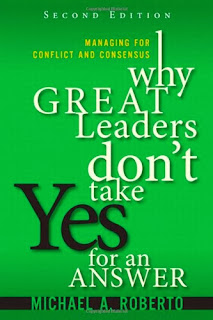
Why Great Leaders Don't Take Yes for an Answer: Managing for Conflict and Consensus, 2nd Edition, Michael A. Roberto

http://www.amazon.com/gp/product/0133095118/ref=as_li_ss_tl?ie=UTF8&camp=1789&creative=390957&creativeASIN=0133095118&linkCode=as2&tag=freemanagementzon-20


From the Back Cover
Praise for the First Edition

“Why Great Leaders Don’t Take Yes for an Answer addresses a perennial and pernicious thorn in the leader’s side—the yes-men in every organization. (And if you think your company is without them, you really need this book!) Leaders at all levels can use Roberto’s advice to make better decisions and align their teams for results.”
—KEN BLANCHARD, Coauthor of The One Minute Manager® and Customer Mania

“Deciding how to decide is a powerful idea that all leaders should understand and put into practice. In doing so, they can become adept at stimulating candid dialogues, testing their company’s core assumptions, and achieving alignment. Roberto’s ideas have already begun to make a profound difference in the effectiveness of our management meetings. Our clients around the world would do well to adopt Roberto’s straightforward recommendations.”
—ED BOSWELL, President and CEO, The Forum Corporation

“Too often leaders mistake silence for agreement. Roberto offers concrete advice on how to beat this trap. A must-read for leaders at all levels.”
—KATHLEEN M. EISENHARDT, Stanford W. Ascherman M. D. Professor, Stanford University and Codirector, Stanford Technology Ventures Program

“In his book Why Great Leaders Don’t Take Yes for an Answer, Roberto provides a unique and very enlightening look into the process of decision making. His thesis around ‘critical consensus building’ is worthwhile reading for any manager or entrepreneur that strives to be the most effective leader they can be.”
—JONATHAN KRAFT, Vice Chairman, New England Patriots

“Unasked questions and undermined decisions are the two main reasons for corporate failure. To avoid these dangerous wrong turns, every executive should study Roberto’s clear road maps for making and implementing decisions.”
—WILBUR L. ROSS, JR., Chairman of the Board, International Steel Group

Leaders still hear “yes” far too often—and they don’t hear bad news until it’s too late. They imagine they’ve achieved consensus, and then they find their decisions undermined by colleagues who never bought in. They become isolated, and even the most dangerous actions can go unquestioned. This remains an enormous problem for leaders and for the entire organization. But is it inevitable? Absolutely not.

In a new edition of his widely praised bestseller, Michael A. Roberto shows how to stimulate constructive debate that leads to better decisions, deeper consensus, and better results. Now reflecting new research and updated case studies, this edition also integrates more valuable guidance on benefiting from “devil’s advocacy” without introducing negativity or costly delay.

Throughout, Roberto offers powerful new insights into managing teams, mitigating risk, and even promoting ethics through effective governance. Whether you’re a senior executive or a project team member, this book will help you leverage your organization’s immense untapped wisdom to optimize both decisions and performance.

DECIDING HOW TO DECIDE: A BETTER FRAMEWORK

Systematically diagnosing, evaluating, and improving your decision-making processes

BALANCING ASSERTIVENESS AND RESTRAINT

Reaching the right decision without micromanaging its content

OVERCOMING THE SILENT BARRIERS TO CANDOR

Promoting the right conflicts—the ones that lead to clarity and progress

CREATING CONSENSUS WITHOUT COMPROMISING CREATIVITY

Using fair and legitimate processes to achieve closure that’s real, not fake About the Author

Michael Roberto is the Trustee Professor of Management at Bryant University in Smithfield, Rhode Island. He has served on the faculty at Harvard Business School and as a visiting professor at NYU’s Stern School of Business. Over the past decade, Professor Roberto has held a position on the faculty of the Nomura School of Advanced Management in Tokyo, where he teaches an executive program each summer.

Professor Roberto’s previous book, Know What You Don’t Know (Pearson/Financial Times, 2009) addresses how leaders can become more effective problem finders. He has created two best-selling audio and video lecture series for The Great Courses ( The Art of Critical Decision Making , 2009, and Transformational Leadership , 2011). His articles have appeared in publications such as Harvard Business Review , MIT Sloan Management Review , and California Management Review.

Professor Roberto’s research and teaching have earned several major awards. The Everest Leadership and Team Simulation earned an MITX Interactive Award for Best E-Learning Solution in 2011. Columbia’s Final Mission , a multimedia case study about the 2003 space shuttle accident, garnered the software industry’s prestigious Codie Award in 2006. On the teaching front, Professor Roberto is a seven-time winner of the Outstanding MBA Teaching Award at Bryant University. He has been awarded Harvard’s Allyn Young Prize for Teaching in Economics on two occasions. Professor Roberto received an AB with honors from Harvard College, an MBA with High Distinction from Harvard Business School, and a doctorate from the Harvard Business School.

Professor Roberto lives in Massachusetts with his wife, Kristin, and his three children, Luke, Celia, and Grace.

Product Details :
  • Hardcover: 304 pages
  • Publisher: FT Press; 2 edition (May 19, 2013)
  • Language: English
  • ISBN-10: 0133095118
  • ISBN-13: 978-0133095111
  • Product Dimensions: 1.1 x 6.1 x 9.1 inches

More Details about Why Great Leaders Don't Take Yes for an Answer: Managing for Conflict and Consensus, 2nd Edition

Tuesday, December 3, 2013

Theory Building in Applied Disciplines (Publication in the Berrett-Koehler Organizational Performance), 1st Edition, Richard A. Swanson


A Comprehensive Method, Tools, and Techniques for Building Sound Theory

Richard Swanson and Thomas Chermack present a complete five-step approach for developing sound theory in applied disciplines, from conceptualizing a theory to creating relevant assessment criteria, establishing a research agenda to test the theory’s validity, applying the theoretical concepts in the real world, and using that experience to further refine and improve the theory. The method is not restricted to any single discipline, nor is it limited by any research ideology. The authors provide a set of tools for each phase of the process, making this book accessible to a wide audience. And in addition to examples in each chapter, they offer two extended case examples of full theory building.

Review
“Swanson and Chermack argue that applied disciplines falter when either theory or practice dominates. The method of theory building in applied disciplines presented and detailed in this book is simple yet powerful.” —Wayne F. Cascio, Robert H. Reynolds Chair in Global Leadership and Professor of Management, Business School, University of Colorado Denver

“Theory Building in Applied Disciplines is a long-overdue book. Swanson and Chermack have made a truly significant contribution to the development of practice-based theories that will enrich applied disciplines.” —Marshall Scott Poole, Professor of Communication, University of Illinois at Urbana-Champaign

“This book practices what it preaches by meshing theory and practice in an accessible and rigorous way. Scholars and graduate students will benefit from the advice and examples provided.” —Kevin Dooley, Distinguished Professor of Supply Chain Management, Arizona State University

“This is a welcome addition to the growing conversation on the role of theory and theory development in applied disciplines.” —David Whetten, Jack Wheatley Professor of Organizational Studies, Brigham Young University

“Swanson and Chermack’s excellent presentation and expansion of the phases of theory building in applied disciplines represents a significant contribution to the scholarly literature.” —Pedro Reyes, Executive Vice Chancellor for Academic Affairs, The University of Texas System

About the Author
Richard A. Swanson is Professor Emeritus of Organizational Leadership, Policy, and Development at the University of Minnesota. He is the author of fourteen books.

Thomas J. Chermack is Associate Professor of Organizational Performance and Change and Director of the Scenario Planning Institute at Colorado State University. He is the author of Scenario Planning in Organizations.

Product Details :

  • Series: Publication in the Berrett-Koehler Organizational Performance
  • Paperback: 240 pages
  • Publisher: Berrett-Koehler Publishers (August 5, 2013)
  • Language: English
  • ISBN-10: 1609947134
  • ISBN-13: 978-1609947132
  • Product Dimensions: 6.1 x 9.2 inches


More Details about Theory Building in Applied Disciplines (Publication in the Berrett-Koehler Organizational Performance), 1st Edition

Competing Values Leadership: Creating Value in Organizations (New Horizons in Management), 1st Edition, Kim S. Cameron


Creating value in a firm is an enormously complex endeavor. Yet, despite its complexity, value creation is the objective of every enterprise, every worker, and every leader. The Competing Values Framework can help leaders understand more deeply and act more effectively. In the first book to comprehensively present this framework, the authors discuss its core elements and focus attention on rethinking the notion of value. They emphasize specific tools and techniques leaders can use to institute sustainable change.

The Competing Values Framework was developed in response to the need for a broadly applicable model that would foster successful leadership, improve organizational effectiveness, and promote value creation. It helps leaders think differently about value creation and shows them how to clarify purpose, integrate practices, and lead people. Named one of the 40 most important frameworks in the history of business, it has been studied and tested in organizations for more than 25 years. Currently used by hundreds of firms around the world, the Competing Values Framework serves as a map, an organizing mechanism, a sense-making device, a source of new ideas, and a learning system.

This accessible resource will be of great use to organizational scholars interested in the concepts of value creation, organizational effectiveness, and competing values; to leaders and managers interested in enhancing and creating value in their organizations; and to change agents and consultants who use the Competing Values Framework as part of their intervention strategies or who are looking to help improve organizations.

Review
'This is a very readable and excellently presented volume. It will interest anyone concerned with organizational effectiveness and the competing values model.' - Economic Outlook and Business Review 'I recommend this book to anyone wishing to understand and practice leadership. Leadership is often treated in mutually-exclusive categories, such as Theory X vs. Theory Y, managers vs. leaders, transactional vs. transformative, initiation vs. consideration, etc. The Competing Values Framework presented in this book transcends these dualities. It features eight competing but complementary values that are critical for managing today's complex and pluralistic organizations.

The framework emphasizes the need for balance among the eight leadership roles, and an appreciation of the context, timing, and contingencies when the leadership roles facilitate and inhibit collective endeavors. I have followed the development and testing of the Competing Values Framework over the years. It makes important contributions to both theory and practice. It stimulates positive learning outcomes for students and managers.' - Andrew H. Van de Ven, University of Minnesota, US

About the Author
Kim S. Cameron, Professor of Management and Organization, Robert E. Quinn, Margaret Elliott Tracey Professor of Business Administration, University of Michigan, Jeff DeGraff, Professor of the Practice of Management, Ross School of Management, University of Michigan, Ann Arbor, US and Anjan V. Thakor, John E. Simon Professor of Finance, Olin School of Business, Washington University, US

As a doctoral candidate in business management, I have leadership books growing out of my ears. When I discovered Competing Values Leadership, I prepared myself for the worst, secretly hoping these authors would offer a unique perspective on leadership that not only offers value but also demonstrates how leadership affects the bottom line in business. Fortunately, I wasn't disappointed.

Competing Values Leadership is organized into two main parts, sub-divided into nine chapters. It includes a list of figures and tables used throughout the book to demonstrate key components of the Competing Values Leadership framework.

Part I overviews the competing values theory and explains the four-quadrant visual model underlying this theory. The authors propose that "hundreds of organizations have used the framework to diagnose and implement culture change, establish competitive strategy, motivate employees, facilitate organizational development and change, implement quality processes, (and) develop high potential leaders..." (p. 12).

Cases including Philips Electronics, Dana Corporation, Dell, General Dynamics, and SPX are provided to demonstrate value created by application of the framework which is divided into quadrants describing four value-creating leadership activities: Collaborate, Create, Compete and Control. The authors assert that balanced application of these competing values, preferences, and priorities which exist in all organizations will yield more value and better financial results.

Part II discusses additional applications of the model and how behaviors of the Competing Values Leadership model can result in value creation and higher financial performance.

Since the authors are researchers and academics, Competing Values Leadership is not a book easily examined cover-to-cover. It's filled with quantitative charts and research terms like "multiple regression" and "predictive analysis" unfamiliar to the typical business audience. Yet, once readers wade through the academic jargon, they will discover that the Competing Values Leadership model offers valuable insights into the inherent paradox of leadership and why leadership is actually a balancing act among extremes rather than a simple fix for organizational challenges.

Armchair Interviews highly recommends this book for business professionals and leadership researchers interested in understanding a new approach to leading people, building organizational effectiveness, and achieving higher financial performance.

Product Details :

  • Series: New Horizons in Management
  • Paperback: 192 pages
  • Publisher: Edward Elgar Publishing (September 26, 2007)
  • Language: English
  • ISBN-10: 1847204953
  • ISBN-13: 978-1847204950
  • Product Dimensions: 5.8 x 9 inches


More Details about Competing Values Leadership: Creating Value in Organizations (New Horizons in Management), 1st Edition

Friday, November 29, 2013

Instructional Design: The ADDIE Approach, 1st Edition, Robert Maribe Branch


The Analyze, Design, Develop, Implement, and Evaluate (ADDIE) process is used to introduce an approach to instruction design that has a proven record of success. Instructional Design: The ADDIE Approach is intended to serve as an overview of the ADDIE concept. The primary rationale for this book is to respond to the need for an instruction design primer that addresses the current proliferation of complex educational development models, particularly non-traditional approaches to learning, multimedia development and online learning environments.

Many entry level instructional designers and students enrolled in related academic programs indicate they are better prepared to accomplish the challenging work of creating effective training and education materials after they have a thorough understanding of the ADDIE principles. However, a survey of instructional development applications indicate that the overwhelming majority of instructional design models are based on ADDIE, often do not present the ADDIE origins as part of their content, and are poorly applied by people unfamiliar with the ADDIE paradigm.

The purpose of this book is to focus on fundamental ADDIE principles, written with a minimum of professional jargon. This is not an attempt to debate scholars or other educational professionals on the finer points of instructional design, however, the book's content is based on sound doctrine and supported by valid empirical research. The only bias toward the topic is that generic terms will be used as often as possible in order to make it easy for the reader to apply the concepts in the book to other specific situations.

From the Back Cover
The Analyze, Design, Develop, Implement, and Evaluate (ADDIE) process is used to introduce an approach to instruction design that has a proven record of success. Instructional Design: The ADDIE Approach is intended to serve as an overview of the ADDIE concept. The primary rationale for this book is to respond to the need for an instruction design primer that addresses the current proliferation of complex educational development models, particularly non-traditional approaches to learning, multimedia development and online learning environments.

Many entry level instructional designers and students enrolled in related academic programs indicate they are better prepared to accomplish the challenging work of creating effective training and education materials after they have a thorough understanding of the ADDIE principles. However, a survey of instructional development applications indicate that the overwhelming majority of instructional design models are based on ADDIE, often do not present the ADDIE origins as part of their content, and are poorly applied by people unfamiliar with the ADDIE paradigm.

The purpose of this book is to focus on fundamental ADDIE principles, written with a minimum of professional jargon. This is not an attempt to debate scholars or other educational professionals on the finer points of instructional design, however, the book's content is based on sound doctrine and supported by valid empirical research. The only bias toward the topic is that generic terms will be used as often as possible in order to make it easy for the reader to apply the concepts in the book to other specific situations.

About the Author
Robert Maribe Branch is a tenured Professor of Instructional Design and Technology at the University of Georgia. Rob earned an Associate degree from New York City Technical College in Brooklyn, New York; a Bachelor of Science degree from Elizabeth City State University, North Carolina; and a Masters degree from Ball State University in Muncie, Indiana. Dr. Branch taught high school in Botswana as a Peace Corps volunteer and later returned to the United States, and completed a Doctor of Education degree from Virginia Tech in Blacksburg, Virginia in 1989 specializing in curriculum development and instructional design. Dr. Branch joined the faculty at Syracuse University and taught graduate courses and conducted research in the Department of Instructional Design, Development and Evaluation, and earned tenure during his seven years there.

Dr. Branch is a former Fulbright Lecturer/Researcher to the University of Natal in South Africa where he helped to inaugurate a Masters degree program in Media Studies. Dr. Branch has co-edited the Educational Media and Technology Yearbook since 1997, and co-authored the two recent editions of the popular Survey of Instructional Development Models book. Dr. Branch emphasizes student-centered learning, teaches courses related to instructional systems design, and consults regularly with governments, businesses and other educational institutions. Dr. Branch’s published research focuses on diagramming complex conceptual relationships and other flow processes.

This book is well written, and the perspective from both business and educational environments is helpful in web site development using a CMS like Weebly. Too often people believe that the focus of a business web site should be on what "they" like, rather than considering the user. The book contains practice cases, and a quiz to test comprehension. I would have appreciated detail of UI and UX, but anyone reading this book would be able to apply those principles effectively. The Bibliography is current and extensive; an added bonus for researchers.

Product Details :

  • Hardcover: 203 pages
  • Publisher: Springer; 2010 edition (October 6, 2009)
  • Language: English
  • ISBN-10: 0387095055
  • ISBN-13: 978-0387095059
  • Product Dimensions: 0.6 x 6.3 x 9.2 inches


More Details about Instructional Design: The ADDIE Approach, 1st Edition

Wednesday, November 27, 2013

Family Business, 4th Edition, Ernesto J. Poza


FAMILY BUSINESS provides the next generation of family business owners with the knowledge and skills needed for the successful management and leadership of the family enterprise. The author, Ernesto Poza, uses both text and cases to explore a diverse set of family firms, examining the interrelationships between the owners, the family, and the management team. FAMILY BUSINESS, at its core, is a practical book that presents management and family practices to model success as well as an honest look at the advantages and challenges facing family enterprises. With an emphasis on leadership and positioning for the future, FAMILY BUSINESS illustrates how the family enterprise can achieve sustained growth and continuity through generations.

Review
Preface. About The Author. Part I. THE FAMILY BUSINESS: WHAT MAKES IT UNIQUE? 1. The Nature, Importance, and Uniqueness of Family Business. 2. Great Families in Business: Building Trust and Commitment. 3. Ownership of An Enterprise Built To Last. Case 1. The Binghams and the Louisville Courier-Journal Companies. Case 2. SMALL FAMILY BUSINESS Power Play at the Inn. Case 3. The Ferre Media Group. Case 4. SMALL FAMILY BUSINESS "She'll Always Be My Little Sister". Case 5. The Vega Food Company.

Part II. LEADERSHIP IMPERATIVES FOR THE FAMILY AND BUSINESS: SUCCESSION AND CONTINUITY. 4. Succession: Continuing Entrepreneurship and The Next Generation. 5. Succession and The Transfer of Power. Case 6. Sigma Motion, Inc. Case 7. SMALL FAMILY BUSINESS The Ambivalent CEO of The Construction Company. Case 8. SMALL FAMILY BUSINESS Borrowing to Grow at Andrews Company. Case 9. SMALL FAMILY BUSINESS Adams Funeral Home. Case 10. Fasteners for Retail (Part A). Case 11. Ferre Media Group (Part B). Case 12. The Cousins Tournament.

Part III. BEST PRACTICES FOR THE MANAGEMENTAND GOVERNANCE OF THE FAMILY BUSINESS. 6. Creating the Strategy. 7. Planning the Estate. 8. Financial Considerations and Valuation of The Family Business. 9. Key Nonfamily Management: The Visible Commitment to Managing The Family Business Professionally. 10. Family Business Governance: Advisory Boards and Boards of Directors. 11. Family Communication: Family Meetings, Family Councils, and Family Offices. 12. Change, Adaptation and Innovation: The Future of Family Business. 13. Continuing The Spirit of Enterprise: Lessons From Centennial Family Companies. Case 13. PrivateCo Business Valuation Report. Case 14. Reliance Industries (Part A). Case 15. SMALL FAMILY BUSINESS The Son-In-Law. Case 16. SMALL FAMILY BUSINESS The New MBA. Case 17. SMALL FAMILY BUSINESS Real Estate Development Partners, Inc. Case 18. SMALL FAMILY BUSINESS Glassking Distributor Company. Case 19. New Way Distributing. Case 20. The Reliance Group (Part B). Index. --This text refers to an alternate Paperback edition.

About the Author
Ernesto Poza is a professor for the Global Entrepreneurship and Family Enterprise at the Thunderbird School of Global Management. His research interests are in the areas of family business continuity, growing the family-led business, governance of family business, and family culture.

Product Details :

  • Paperback: 480 pages
  • Publisher: Cengage Learning; 4 edition (January 28, 2013)
  • Language: English
  • ISBN-10: 1285056825
  • ISBN-13: 978-1285056821
  • Product Dimensions: 9.1 x 6.3 x 0.8 inches


More Details about Family Business, 4th Edition

The Lean 3P Advantage: A Practitioner's Guide to the Production Preparation Process, 1st Edition, Allan R. Coletta


How do you take talented engineers and surround them with the elements needed to create brilliant designs that lead to market-changing products? Lean 3P is how.

Winner of a 2013 Shingo Research and Professional Publication Award !

Written from an operations perspective, The Lean 3P Advantage: A Practitioner’s Guide to the Production Preparation Process explains how to build collaborative thinking and innovation into the front end of the design process. Describing how to develop successful new products concurrently with new operations, the book illustrates real-world scenarios with numerous examples and case studies to help newcomers succeed the first time around. For those familiar with 3P, the book supplies the basis to explore Evergreen 3P—a process for applying 3P to small-scale design projects for similar benefits.

Details the 3P Lean Design process, explaining how and why it works so effectively
Includes case studies and examples of real-world applications
Presents time-tested methods based on the combined experience of numerous practicing companies

Coverage includes product planning and evaluation criteria, selection of alternatives, timing considerations, construction of prototypes, and measuring effectiveness. This book will help you and your team develop holistic designs that foster innovation and deliver products and production operations that effectively utilize people and exceed the expectations of all stakeholders.

Review
Finally, a go-to reference book on the important subject of 3P. Coletta does an outstanding job defining a step-by-step approach that can provide breakthrough results to manufacturing and service organizations alike. —Drew Locher, Managing Director, Change Management Associates

This how-to guide is filled with relevant examples that can help you apply the concepts and methodology to any product and process industry to develop higher quality products and processes delivered at lower costs. —Ken Rolfes, KDR Associates, Inc.

... an extremely valuable book for any practitioner interested in capturing the significant benefits of 3P for their firms. The author’s sincere desire to share his considerable knowledge with his readers comes through on every page. —Ron Mascitelli, PMP, President, Technology Perspectives

About the Author
Allan R. Coletta is a chemical engineer with extensive manufacturing operations, supply chain, and engineering experience gained while working in the chemical process and health-care diagnostics industries. His Lean experience started while serving as site manager for ICI Uniqema’s largest specialty chemicals plant in North America and continued to expand his role as Senior Director of Engineering for Siemens Healthcare Diagnostics. His passion for manufacturing and engaging people in continuous improvement continues to grow through personal application of Lean principles.

Allan serves on the Delaware Manufacturing Extension Partnership’s Fiduciary and Advisory Boards and is a member of the Delaware Business Mentoring Alliance. He is also a member of the American Institute of Chemical Engineers and the Association for Manufacturing Excellence (AME).

Product Details :

  • Paperback: 336 pages
  • Publisher: Productivity Press; 1 edition (March 23, 2012)
  • Language: English
  • ISBN-10: 1439879117
  • ISBN-13: 978-1439879115
  • Product Dimensions: 0.8 x 7 x 10 inches


More Details about The Lean 3P Advantage: A Practitioner's Guide to the Production Preparation Process, 1st Edition

Wednesday, November 20, 2013

Applied Sport Management Skills (With Web Resource), 1st Edition, Robert Lussier


Applied Sport Management Skills uses the four management functions of planning, organizing, leading, and controlling to teach readers how to become strong leaders and managers in the world of sport. This book, along with its companion Web site and online student resource, provides a comprehensive overview of management topics with a unique focus on developing the necessary skills for managing sport organizations.

The text's how-to approach helps students learn by putting into practice what they will be doing as sport managers—including creative problem solving, strategic planning, and developing the skills to lead, organize, and delegate. By taking principles and concepts presented in the text and applying them to professional practice, students will be able to assess how their interests and skills can contribute to the growing sport management field.

Filled with various exercises and real-world examples, Applied Sport Management Skills contains valuable tools to help students understand leadership and management in the sport industry:

-Chapter-opening scenarios, revisited throughout each chapter, provide a cohesive thread to keep students focused on how sport managers use the text concepts on the job. Each chapter also includes several application examples from a variety of sport organizations.

-Case studies in each chapter help students apply their newly gained knowledge to real-life situations.

-Time-outs encourage students to relate chapter concepts to their own experiences through brief assignments and questions.

-Self-assessment exercises enable students to better understand themselves and to determine their strengths and areas of improvement.

-Skill-building exercises provide students with the opportunity to develop skills they can use in their personal and professional lives.

-Application and skill-development sidebars, learning outcomes, key terms, and chapter summaries reinforce key points covered in the chapter. Applied Sport Management Skills includes an extensive instructor guide, test bank, and PowerPoint presentation package to assist instructors with class preparation and presentation and engage students in the material. A companion online student resource (OSR) allows students to use the learning activities from the text in a dynamic and interactive setting. Many activities in the OSR can be filled out, printed, and handed in to the instructor, whereas others provide immediate “correct” or “incorrect” feedback to students. Additional features found only in the OSR include related Internet resources and questions that test students' ability to gather information from sport-related Web sites.

Applied Sport Management Skills provides readers with a thorough understanding of the management principles and concepts used in sport organizations and the challenges that managers face. This understanding is enhanced by the application of that knowledge and by the focus on developing management skills, allowing students to build a solid foundation toward a fulfilling career in sport management.

Includes an online student resource!

To assist students using the text, Applied Sport Management Skills has a companion online student resource (OSR.) Completely integrated with the text, the OSR allows students to experience content through multiple dimensions. Students will receive free access to the OSR with the purchase of a new text, or it may be purchased as a separate component. The companion OSR is a dynamic and interactive tool that allows students to comprehend and practice information presented in the text with a variety of learning activities:

-Time-out sections are one- or two-sentence assignments that require students to think about the material and apply it to a work or sport situation.

-Application exercises reinforce the material from the chapter through the use of a short series of questions and a bank of answers to choose from.

-Review and discussion questions require students to synthesize the material from the chapter and help them fully comprehend the information.

-Self-assessments are interactive exercises that provide insight into students' management styles. The OSR also provides additional learning material, including related Internet resources and questions that test students' ability to gather information from sport-related Web sites. Many activities in the OSR can be filled out, printed, and handed in to the instructor, whereas others provide immediate “correct” or “incorrect” feedback to students.

About the Author
Robert N. Lussier, PhD, is a professor of management at Springfield College in Springfield, Massachusetts, where he has taught undergraduate and graduate sport management students for more than 15 years. He has also supervised sport internships and serves as an advisor for sport management research projects.

Dr. Lussier has authored nearly 300 publications, including texts in management, leadership, and human relations. He was an intercollegiate athlete and has coached at the college, high school, and youth levels. He works out daily and still competes in sports. He also enjoys spending time with his wife and six children.

David C. Kimball, PhD, is an associate professor of management and director of the sport management program at Elms College in Chicopee, Massachusetts. Dr. Kimball teaches sport management and sport marketing courses and coaches and supervises Maccabi athletes each summer. He has an expansive network of friends and acquaintances in the sport management field; many of the case studies in this book arose from these relationships.

He loves being personally involved in sports and runs 30 miles a week while participating in Les Mills training. He also enjoys watching sports on TV.

Product Details :

  • Hardcover: 512 pages
  • Publisher: Human Kinetics; 1 edition (January 6, 2009)
  • Language: English
  • ISBN-10: 073607435X
  • ISBN-13: 978-0736074353
  • Product Dimensions: 1.1 x 8.7 x 11.2 inches


More Details about Applied Sport Management Skills (With Web Resource), 1st Edition

Tuesday, November 19, 2013

Coaching Skills: A Handbook, 3rd Edition, Jenny Rogers


"A straightforward approach to the simple art of coaching conversations, while offering insight into the complexity and sophistication of coaching for those looking to take their practice to the next level." Dr Jonathan Passmore, Independent Consultant “Coaching Skills is much more than just a book containing a wide portfolio of tools, techniques and concepts, brilliantly supported by many case studies. It is a book for practitioners who will find here a profound and accessibly-presented analysis of the most important models, theories and results of research, with detailed links to coaching as well as guidelines on how to deal with the difficult situations and dilemmas faced by coaches.” Dorota Porażka, Managing Partner of DORADCA Consultants Ltd

"Jenny Rogers writes with enviable elegance and simplicity about the skills that coaches need. This third edition is a testament to her belief that coaches never stop learning. In this edition she shares the fruits of her recent reading and experiences. There is a good deal of new material, including a chapter on advances in neuroscience, new insights from the recent coaching literature and new models to consider. But Jenny wears her erudition lightly. She takes the reader by the hand through a complex journey, sharing the excitement of her discoveries but not overwhelming with detail. Her strong personal voice comes through in every sentence, understanding, encouraging, pragmatic. I read it from cover to cover in a weekend, and know I will be back to reread before long." Lis Paice, NHS Mentor of the Year, 2010

"Jenny Roger's clear writing style, straight-forward approach and case examples allow for insight into the coaching process and a glimpse at the learning that occurs for both client and coach. This edition offers even more with enhancements to previous writing and a chapter specifically focused on the brain. Whether you are a coach - new or experienced, a manager or simply interested in learning more about what we do as coaches, this is a must have resource for your library." Diane Brennan, MBA, MCC, Past President of The International Coach Federation (2008) and coeditor, The handbook of knowledge-based coaching: From theory to practice

"This book is a gem for anyone curious about executive coaching - what it is, how it works and how to do it well in practice. As a coaching pioneer and highly accomplished practitioner, Jenny draws upon her extensive experience in coaching, coach training and supervision and brings to life theory and approaches with rich case studies, humour and humility. The third edition benefits from a chapter on the fascinating emerging field of neuroscience and explores early implications for coaching. As with the rest of the book it is accessible, relevant and well researched. I consider "Coaching Skills" to be essential reading for novice and established coaches alike." Sandra Grealy, Director of Coaching, Management Futures Ltd

“Among all the coaching books on the market this book stands out for its clarity and wisdom, and for its engaging and unpretentious voice. In designing a coaching course at Fielding Graduate University, I had no hesitation in making it required reading." Leni Wildflower, PhD, PCC, wildflower-consulting.com

Substantially updated throughout, the latest edition has new material on coaching and the human brain, working with clients on their self-limiting beliefs, new models of understanding what coaching is and being a coach during the psychological stresses of a severe economic recession.

Coaching Skills is a popular text for coach training schools all over the world, brought to life with dozens of case studies and practical guidance, while also emphasizing the importance of underpinning psychological awareness and understanding.

This book will support you whether you are an experienced coach working with senior executives, or a beginner taking your first steps on the journey to becoming a master-practitioner. The book answers questions such as:

Are there really boundaries between coaching, therapy and training, or is it all more fluid than many people acknowledge?
Which tools and techniques pay dividends every time and which should you avoid?
What are the magic ingredients that determine whether the coach-client relationship works?
Why are goal-setting and questioning such important skills for any coach and how can you acquire them?
How as a coach can you work with clients to make truly transformational changes in their lives?

About the Author
Jenny Rogers is an executive coach with more than 20 years’ experience. Her clients are typically senior leaders from a wide range of sectors. She has also trained many hundreds of coaches and managers in coaching skills. As a writer Jenny has published more than 70 books on topics which include adult learning, influencing, facilitation skills and career management.

This was a textbook for my graduate level coaching program. It was a pleasure to read, useful and a reference I plan to keep! I highly recommend it.

Product Details :

  • Paperback: 304 pages
  • Publisher: Open University Press; 3 edition (March 1, 2012)
  • Language: English
  • ISBN-10: 0335245595
  • ISBN-13: 978-0335245598
  • Product Dimensions: 0.8 x 5.8 x 8.8 inches


More Details about Coaching Skills: A Handbook, 3rd Edition

Monday, November 18, 2013

Managerial Economics: Applications, Strategies and Tactics (Upper Level Economics Titles), 13rd Edition, James R. McGuigan


By illustrating how effective managers apply economic theory and techniques to solve real-world problems, MANAGERIAL ECONOMICS 13E helps future business leaders learn to think analytically and make better decisions. As always, the seasoned author team balances a solid foundation of traditional microeconomic theory with extensive exploration of the latest analytical tools in managerial economics, such as game-theoretic tactics, information economics, and organizational architecture. This new edition is concise, comprehensive, and current with cutting-edge coverage of important management topics relevant to today's students, including an exciting focus on "green" business and environmentally friendly practices and products.

Review
Preface. About the Authors. PART I: INTRODUCTION. 1. Introduction and Goals of the Firm. 2. Fundamental Economic Concepts. PART II: DEMAND AND FORECASTING. 3. Demand Analysis. 4. Estimating Demand. 4A. Problems in Applying the Linear Regression Model. 5. Business and Economic Forecasting. 6. Managing in the Global Economy. 6A. Foreign Exchange Risk Management. PART III: PRODUCTION AND COST. 7. Production Economics. 7A. Maximization of Production Output Subject to a Cost Constraint. 7B. Production Economics of Renewable and Exhaustible Natural Resources. 8. Cost Analysis. 8A. Long-Run Costs with a Cobb-Douglas Production Function. 9. Applications of Cost Theory. PART IV: PRICING AND OUTPUT DECISIONS: STRATEGY AND TACTICS. 10. Prices, Output, and Strategy: Pure and Monopolistic Competition. 11. Price and Output Determination: Monopoly and Dominant Firms. 12. Price and Output Determination: Oligopoly. 13. Best-Practice Tactics: Game Theory. 13A. Entry Deterrence and Accommodation Games. 14. Pricing Techniques and Analysis. PART V: ORGANIZATIONAL ARCHITECTURE AND REGULATION. 15. Contracting, Governance, and Organizational Form. 15A. Auction Design and Information Economics. 16. Government Regulation. 17. Long-Term Investment Analysis. Appendices. A. The Time Value of Money. B. Tables. C. Differential Calculus Techniques in Management . D. Check Answers to Selected End-of-Chapter Exercises. Glossary. Index. Notes. Web Appendices.

About the Author
James R. McGuigan owns and operates his own numismatic investment firm. Prior to this business, he was Associate Professor of Finance and Business Economics in the School of Business Administration at Wayne State University. He also taught at the University of Pittsburgh and Point Park College. McGuigan received his undergraduate degree from Carnegie-Mellon University; MBA at the Graduate School of Business at the University of Chicago and his PhD from the University of Pittsburgh. In addition to his interests in economics, he has coauthored books on financial management.

R. Charles Moyer earned his BA in Economics from Howard University and his MBA and PhD in Finance and Managerial Economics from the University of Pittsburgh. Professor Moyer is Dean Emeritus of the College of Business at the University of Louisville, and Professor of Finance and Entrepreneurship. He is Dean Emeritus and former holder of the GMAC Insurance Chair in Finance at the Babcock Graduate School of Management, Wake Forest University. Previously, he was Professor of Finance and Chairman of the Department of Finance at Texas Tech University. Professor Moyer also has taught at the University of Houston, Lehigh University, and the University of New Mexico and spent a year at the Federal Reserve Bank of Cleveland.

Professor Moyer has taught extensively abroad in Germany, France, and Russia. In addition to this text, Moyer has coauthored two other financial management texts. He has been published in many leading journals including FINANCIAL MANAGEMENT, JOURNAL OF FINANCIAL AND QUANTITATIVE ANALYSIS, JOURNAL OF FINANCE, FINANCIAL REVIEW, JOURNAL OF FINANCIAL RESEARCH, INTERNATIONAL JOURNAL OF FORECASTING, JOURNAL OF ECONOMICS AND BUSINESS, STRATEGIC MANAGEMENT JOURNAL and JOURNAL OF INDUSTRIAL ORGANIZATION. Professor Moyer has been a member of the Board of Directors of King Pharmaceuticals, Inc., and is on the board of Capital South Partners, the Kentucky Seed Capital Fund, and Summit Biosciences.

Frederick H. deB. Harris (Rick) is the John B. McKinnon Professor of Economics and Finance at the Schools of Business, Wake Forest University. Professor Harris holds a 1981 Ph.D. from the University of Virginia and a Dartmouth College A.B. in Economics. His specialties are pricing tactics and capacity planning in product markets as well as price discovery in financial markets and security market design. He has taught integrative managerial economics Core courses and elective B.A., B.S., M.S., M.B.A., and Ph.D. courses at Wake Forest, the University of Texas, and William and Mary, as well as several universities in France, Italy, Germany, and Australia. Professor Harris has won two school-wide Educator of the Year awards and two Researcher of the Year awards.

Other recognitions include Outstanding Faculty (Inc., 1998 and 2001), Outstanding Faculty (Business Week's Guide to the Best Business Schools, 1997-2004), Board of Associate Editors (Journal of Industrial Economics, 1988-2003), and the Runner-up Prize (European Corporate Governance Institute, 2007). Numerous publications have appeared in the leading journals in Economics, Finance, and Operations such as the REVIEW OF ECONOMICS AND STATISTICS, THE JOURNAL OF FINANCIAL AND QUANTITATIVE ANALYSIS, JOURNAL OF FINANCIAL MARKETS, and THE JOURNAL OF OPERATIONS MANAGEMENT. He also writes with practitioners in the JOURNAL OF TRADING from Institutional Investor Inc. and in the INFORMS's JOURNAL OF REVENUE AND PRICING MANAGEMENT.

Product Details :

  • Series: Upper Level Economics Titles
  • Hardcover: 768 pages
  • Publisher: Cengage Learning; 13 edition (July 16, 2013)
  • Language: English
  • ISBN-10: 1285420926
  • ISBN-13: 978-1285420929
  • Product Dimensions: 10.1 x 8 x 1.4 inches


More Details about Managerial Economics: Applications, Strategies and Tactics (Upper Level Economics Titles), 13rd Edition